54 prognostic variables found in literature search, 23 variables for mortality and 20 variables for hospitalization selected by experts’ panel.
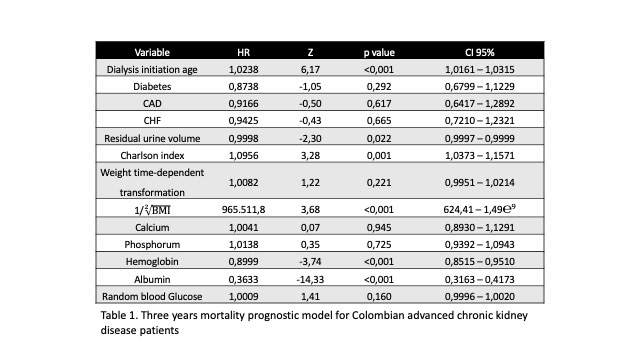
Three-year mortality model development cohort included 2.343 patients, 983 (41,95%) women, median age 61,6 years (IQR= 21,6), the prognostic model was built with statistically significant variables from bivariate analysis: dialysis initiation age, coronary artery disease, diabetes mellitus, congestive heart failure, residual urine volume, Charlson index, weight (time-dependent transformation), corporal mass index (1/sqrt*X transformation), serum calcium, serum phosphorus, hemoglobin, serum albumin and random blood glucose. Discrimination C-index: 0,9404; calibration joint test: p=0,649; net benefit with probability threshold: 12%. Internal validation: C-index: 0,9447; calibration: p= 0,542; net benefit with probability threshold: 11%. External validation cohort included 3.688 patients, 560 (42,30%) women, median age 61,5 years (IQR= 20,9); C-index: 0,9463; calibration: p=0,184; net benefit with probability threshold: 13,5%.
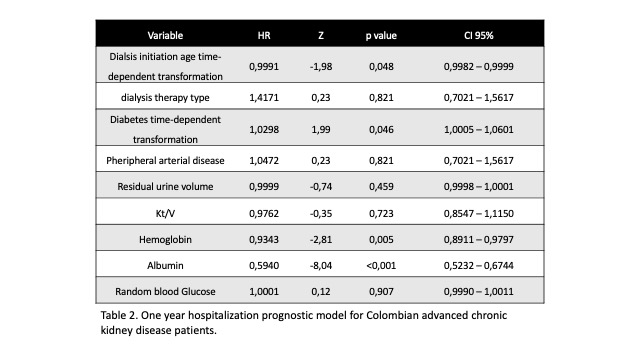
One-year hospitalization development model cohort with 2.819 patients, median age 62,1 years (IQR: 21,6), 42,36% women. Selected variables: dialysis initiation age (time-dependent), dialysis therapy type, diabetes mellitus (time-dependent), peripheral arterial disease, residual urine volume, Kt/V, hemoglobin, serum albumin and random blood glucose; discrimination C-index: 0,8962; calibration: p=0,948; net benefit with probability threshold: 25%. Internal validation: C-index: 0,8959; Calibration: p=0,776; net benefit with probability threshold: 24%. External validation cohort: 4.054 patients, mean age 61,0 years (IQR: 20,6), 43,62% women; C-index: 0,9089; Calibration: p=0,135; net benefit with probability threshold: 25%