THE OUTCOME OF ACUTE KIDNEY DISEASE IN CRITICALLY ILL ADULT PATIENTS: A PROSPECTIVE OBSERVATIONAL STUDY


Certificate Output Instructions

For best output, select "Paper Size" as "A4" and "Margin" as "0" or "None".

To save or print to PDF, please select Print Destination > Save as PDF, enable Background Graphics under "More Settings", then click "Save".


Certificate Background


Presented the abstract " "
(Abstract co-author(s):  )


E-Poster Presentation

During the congress, E-Posters will be accessible to all participants on the congress website 24/7, as well as in the E-poster stations in the congress center. 

Preparing your E-Poster

Please review the E-Poster format requirements carefully when preparing your E-Poster. Should your E-Poster not meet the mentioned requirements, it may not be displayed as described above.

​E-Poster Submission Deadline

Please prepare and upload your E-Poster no later than March 14, 2026 11.59PM CET. After this date, you will no longer be able to prepare and upload your E-poster and it will not be displayed and accessible on the congress website.​

E-Poster Format Requirements
  • PDF file
  • Layout: Portrait (vertical orientation)
  • One page only (Dim A4: 210 x 297mm or PPT)
  • E-Poster can be prepared in PowerPoint (one (1) PowerPoint slide) but must be saved and submitted as PDF file.
  • File Size: Maximum file size is 2 Megabytes (2 MB)
  • No hyperlinks, animated images, animations, and slide transitions
  • Language: English
  • Include your abstract number
  • E-posters can include QR codes, tables and photos
https://storage.unitedwebnetwork.com/files/1099/5a4cfcacf8641c35be1b0a45ec61bd66.pdf
THE OUTCOME OF ACUTE KIDNEY DISEASE IN CRITICALLY ILL ADULT PATIENTS: A PROSPECTIVE OBSERVATIONAL STUDY

Please follow the instructions below to input your abstract title.

Abstract titles should be brief and reflect the content of the abstract.

  • The title will not be accepted if it exceeds 25 words.
  • Type in CAPITAL LETTERS.
  • Lowercase may be used for abbreviations only, for example, mRNA.
Sai
Saran
Sai Saran saisaranpv@gmail.com Sanjay Gandhi Postgraduate Institute of Medical Sciences (SGPGIMS) Critical Care Medicine Lucknow India *
Bhanuprakash Bhaskar bhanupicu@gmail.com Medeor Hospital Critical Care Medicine Dubai United Arab Emirates -
Mohan Gurjar m.gurjar@rediffmail.com Sanjay Gandhi Postgraduate Institute of Medical Sciences (SGPGIMS) Critical Care Medicine Lucknow India -
Narayan Prasad narayan.nephro@gmail.com Sanjay Gandhi Postgraduate Institute of Medical Sciences (SGPGIMS) Nephrology Lucknow India -
Anupama Kaul anupmaneph@gmail.com Sanjay Gandhi Postgraduate Institute of Medical Sciences (SGPGIMS) Nephrology Lucknow India -
Dharmendra Bhadauria docdharm10@gmail.com Sanjay Gandhi Postgraduate Institute of Medical Sciences (SGPGIMS) Nephrology Lucknow India -
Harshit Singh rajatharsh@gmail.com Sanjay Gandhi Postgraduate Institute of Medical Sciences (SGPGIMS) Nephrology Lucknow India -
Vikas Agarwal Vikasagr@yahoo.com Sanjay Gandhi Postgraduate Institute of Medical Sciences (SGPGIMS) Immunology Lucknow India -
Anamika Anuja anamika.anuja23@gmail.com Sanjay Gandhi Postgraduate Institute of Medical Sciences (SGPGIMS) Immunology Lucknow India -
Saurabh Chathurvedi saurabhchaturvedi267@gmail.com Sanjay Gandhi Postgraduate Institute of Medical Sciences (SGPGIMS) Immunology Lucknow India -
Banani Poddar bananip@hotmail.com Sanjay Gandhi Postgraduate Institute of Medical Sciences (SGPGIMS) Critical Care Medicine Lucknow India -
Afzal Azim draazim2002@gmail.com Sanjay Gandhi Postgraduate Institute of Medical Sciences (SGPGIMS) Critical Care Medicine Lucknow India -
Prabhaker Misra mishrapk79@gmail.com Sanjay Gandhi Postgraduate Institute of Medical Sciences (SGPGIMS) Biostatistics and Health Informatics Lucknow India -
-
-

The term acute kidney disease (AKD) was introduced by the Acute Disease Quality Initiative 16 workgroup in 2017, and it is believed to differ from acute kidney injury (AKI) in terms of pathophysiology, reversibility and/or progression to chronicity. A proportion of critically ill adults develop AKD during stay in the intensive care unit (ICU), with unclear evidence as to the clinical course and renal outcomes at and after ICU discharge. The present study aimed to evaluate major adverse kidney events (MAKE) at 90 days, in addition to validated kidney injury biomarkers in critically ill adults diagnosed de-novo with AKD during ICU stay.

After ethical approval, and registration (ClinicalTrials.gov Identifier: NCT03597854), this single-center, prospective study was carried out in a 20-bedded ICU of a tertiary care, public-sector, academic hospital between Jun 2018 and October 2019. All adult (age>18 years) ICU patients, who had baseline eGFR > 60 ml/min/1.73m2 prior to ICU admission and had an eGFR < 60 ml/min/1.73m2 during ICU stay, for a duration of > 7 days, were defined as having AKD and were considered for inclusion. Patients with unknown baseline serum creatinine, known chronic kidney disease, post-renal transplant status and pregnant patients were excluded. Patients whose serum creatinine recovered or patients who died within 7 days after the diagnosis of AKI were excluded. Clinical characteristics were recorded after obtaining written informed consent. Blood (ng/mL) and urine samples (ng/mg of Ucr: urinary creatinine) were collected for analyzing creatinine and neutrophil-gelatinase-associated-lipocalin (NGAL), kidney-injury molecule-1 (KIM-1) on day 7 (designated as day of onset of AKD) and ICU discharge. MAKE 90 was defined as occurrence of any one of the following outcomes: death from any cause < 90 days, dependence on renal replacement therapies or doubling of serum creatinine.


During study period, 520 adult patients were admitted; of them, 401 were excluded (235 had no AKI; 96 had AKI, but died within 7 days of AKI, 58 had pre-existing renal disease; 12 were pregnant).  A total of 119 patients were included in the present study, median age of 38 years (29-52), 68.9% were male, predominantly (82.4%) with medical illness preceding ICU admission. Up to 85% and 82% of these patients were on mechanical ventilatory and vasopressor support respectively. Mortality in the study cohort in ICU was 42.9% (n=51). MAKE 90 outcome occurred in 43.7 % (n=52) of the study population. Among patients with MAKE 90 outcome, plasma NGAL: 4538 (3896-4736) versus 3979 (2146-4654); p=0.05, urine NGAL: 1451 (1128-1925) versus 1124 (1004-1411); p= 0.02, plasma KIM1 levels : 499 (148-1089) versus 240 (55.6-326); p=0.03, were significantly higher on day of AKD onset (day7), while plasma NGAL: 4536 (3456-4878) versus 1604 (1110-2075) ; p=0.02, and plasma KIM:1756 (486-826) versus 159 (117-200) ;p=0.02, were significantly higher at ICU discharge compared to patients who did not achieve MAKE 90 outcome. Also, plasma and urinary biomarkers at day 90 (n=25) (all in patients with serum creatinine resolution), remained well above accepted cut-off values for plasma NGAL, urine NGAL and plasma KIM-1 among 44%, 64% and 96% of study participants, respectively. 

Table 1: Baseline characteristics of the study participants(n=119)

Baseline Characteristics (n=119)

Median (IQR)/number (%)

Age (years)

38 (29-52)

Male

82 (68.9)

Type of admission (medical)

98 (82.4)

No. on mechanical ventilator

102 (85)

No. on vasopressor supports

98 (82)

Charlson co-morbidity index

1 (0-2)

Vasopressor days

5 (3-8)

Mechanical ventilation days

8 (6-12)

APACHE_II

16 (11-21)

Admission SOFA

9 (6-12)

AKI stage at ICU admission (0/1/2/3)

14/31/29/45

Creatinine (mg/dL) at ICU admission (mg/dL)

1.9 (1.21-3.45)

Abbreviations used: APACHE: acute physiology and chronic health evaluation; SOFA: sequential organ failure score ; AKI: acute kidney injury; ICU: intensive care unit

Table 2: Outcome parameters of the study participants (n=119)

Outcome parameters (n=119)

Median (IQR)/number (%)

Day of diagnosis of AKI during ICU stay

5 (3-6)

LOS_ICU (days)

12 (7-15)

LOS_hosp (days)

15 (12-21)

28-day mortality

51 (42.9)

AKD at discharge (n=68)

AKD stage (0/1/2/3)

RRT dependent


57/2/4/5

6

Creatinine (mg/dL) at ICU discharge (n=68)

0.79 (0.57-1.0)

AKD at 90 days (n=29)

Stage 0/1/2/3

RRT dependent


28/0/0/1

01

Abbreviations used: LOS_ICU: length of stay intensive care unit; LOS_hosp: Length of stay hospital; AKD: acute kidney disease; RRT: renal replacement therapy

Table 3: Biomarker levels in study participants at the diagnosis of AKD, ICU discharge in survivors and 90day post AKI diagnosis. (#: lost to follow up: 43)

Biomarker

Median (IQR)

At AKD diagnosis (n=119)

P-NGAL (ng/ml)

4099 (3449-4701)

U-NGAL (ng/mg of UCr) (n=106)

1263 (1038-1796)

P-KIM-1 (ng/ml)

297 (111-881)

U-KIM-1 (ng/ml) (n=106)

883 (462-1533)

At ICU discharge (n= 68)

P-NGAL (ng/ml)

1412 (1113-1843)

U-NGAL(ng/ml) (n=63)

658 (178-897)

P-KIM-1 (ng/ml)

121 (45-186)

U-KIM-1 (ng/mg of Ucr) (n=63)

297 (174- 297)

At 90 days post AKI diagnosis (n=25#)


P-NGAL(ng/ml)

167 (114-367)

U-NGAL(ng/ml)

117 (47-299)

P-KIM-1 (ng/ml)

56 (44-73)

U-KIM-1(ng/mg of Ucr)

56 (43-77)

Abbreviations used: P-NGAL: Plasma-Neutrophil-Gelatinase-Associated-Lipocalin (NGAL), P-KIM-1: plasma kidney-injury molecule-1 (KIM-1); U-NGAL: Urine- Neutrophil-Gelatinase-Associated-Lipocalin (NGAL),U-KIM-1: Urine kidney-injury molecule-1 (KIM-1); AKD: acute kidney disease; AKI: acute kidney injury.  

Table 4: Comparison of plasma and urinary biomarkers in patients with and without MAKE 90 outcome


With MAKE 90 (n=52)

Without MAKE 90(n=34)

p-value

At the onset of AKD

P-NGAL (ng/ml)

4538 (3896-4736)

3979 (2146-4654)

0.05

U-NGAL (ng/mg of UCr)

1451 (1128-1925)

1124 (1004-1411)

0.02

P-KIM   (ng/ml)

499 (148-1089)

240 (55.6-326)

0.03

U-KIM(ng/mg of UCr)

789(333-1364)

895 (545-1860)

0.45

At ICU discharge

P-NGAL (ng/ml)

4536 (3456-4878)

1604 (1110-2075)

0.02

U-NGAL (ng/mg of UCr)

-

647 (135-864)

0.48

P-KIM   (ng/ml)

756 (486-826)

159 (117-200)

0.02

U-KIM(ng/mg of UCr)

-

174 (135-385)

0.97

At day 90

P-NGAL (ng/ml)

261

163 (114-357)

0.59

U-NGAL (ng/mg of UCr)

-

132 (46-331)

-

P-KIM   (ng/ml)

56

56 (44.3-75.4)

1.0

U-KIM(ng/mg of UCr)

-

57 (42-77.6)

-

Abbreviations used: Abbreviations used: P-NGAL: Plasma-Neutrophil-Gelatinase-Associated-Lipocalin (NGAL), P-KIM-1: plasma kidney-injury molecule-1 (KIM-1); U-NGAL: Urine- Neutrophil-Gelatinase-Associated-Lipocalin (NGAL),U-KIM-1: Urine kidney-injury molecule-1 (KIM-1); AKD: acute kidney disease; AKI: acute kidney injury.  

Figure 1: Progression of biomarkers in patients with AKD at different time points.
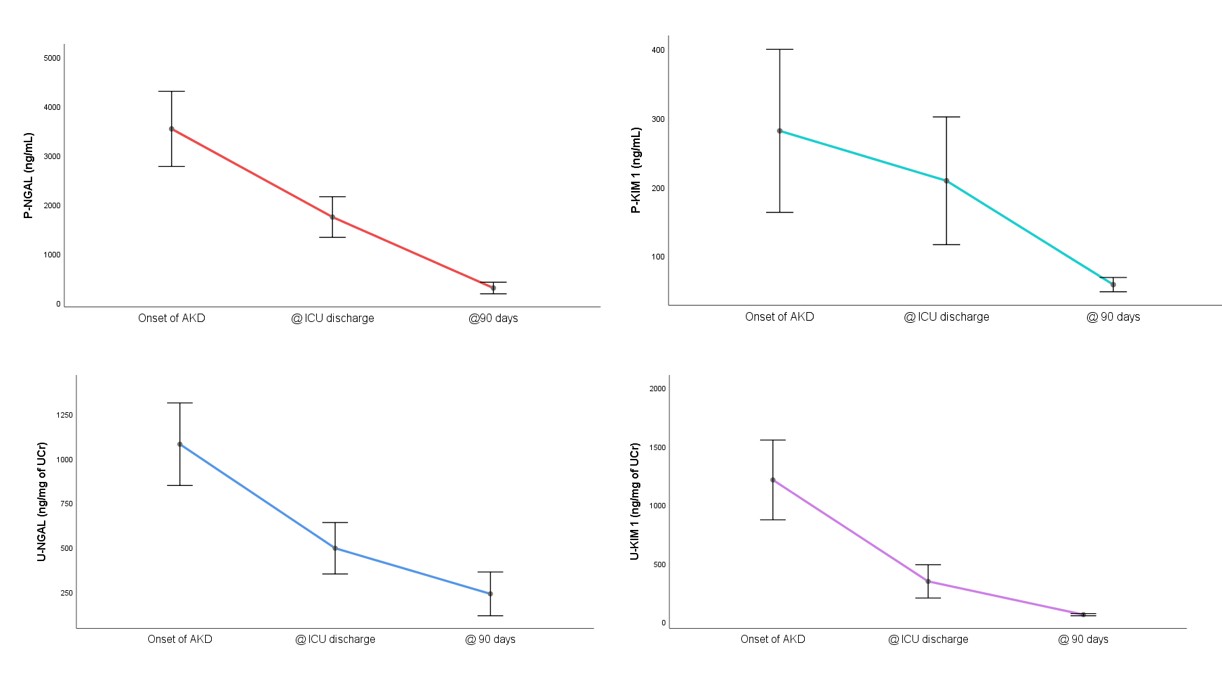
Among critically ill adults with AKD, the present study showed mortality of 42.9% with development of MAKE 90 outcome in 43.7%. Plasma and urinary NGAL and KIM-1 at day 7 were significantly higher in those who had MAKE 90 outcome than those without. Plasma and urinary biomarkers at day 90 (n=25), in patients with serum creatinine resolution, remained well above accepted cut-off values for plasma NGAL, urine NGAL and plasma KIM-1 among 44%, 64% and 96% of study participants, respectively.

Kewords
