STING Disrupts ER–Mitochondrial Contact to Promote Phospholipid Metabolic Dysfunction in Sepsis-Associated AKI


Certificate Output Instructions

For best output, select "Paper Size" as "A4" and "Margin" as "0" or "None".

To save or print to PDF, please select Print Destination > Save as PDF, enable Background Graphics under "More Settings", then click "Save".


Certificate Background


Presented the abstract " "
(Abstract co-author(s):  )


E-Poster Presentation

During the congress, E-Posters will be accessible to all participants on the congress website 24/7, as well as in the E-poster stations in the congress center. 

Preparing your E-Poster

Please review the E-Poster format requirements carefully when preparing your E-Poster. Should your E-Poster not meet the mentioned requirements, it may not be displayed as described above.

​E-Poster Submission Deadline

Please prepare and upload your E-Poster no later than March 14, 2026 11.59PM CET. After this date, you will no longer be able to prepare and upload your E-poster and it will not be displayed and accessible on the congress website.​

E-Poster Format Requirements
  • PDF file
  • Layout: Portrait (vertical orientation)
  • One page only (Dim A4: 210 x 297mm or PPT)
  • E-Poster can be prepared in PowerPoint (one (1) PowerPoint slide) but must be saved and submitted as PDF file.
  • File Size: Maximum file size is 2 Megabytes (2 MB)
  • No hyperlinks, animated images, animations, and slide transitions
  • Language: English
  • Include your abstract number
  • E-posters can include QR codes, tables and photos
 
STING Disrupts ER–Mitochondrial Contact to Promote Phospholipid Metabolic Dysfunction in Sepsis-Associated AKI

Please follow the instructions below to input your abstract title.

Abstract titles should be brief and reflect the content of the abstract.

  • The title will not be accepted if it exceeds 25 words.
  • Type in CAPITAL LETTERS.
  • Lowercase may be used for abbreviations only, for example, mRNA.
Dongxue
Xu
Dongxue Xu xudongxue@whu.edu.cn Zhongnan Hospital Wuhan University Wuhan China *
Xiaoyu Zhang zxy1011@whu.edu.cn Zhongnan Hospital Wuhan University Wuhan China -
Yiming Li lym-fly@whu.edu.cn Zhongnan Hospital Wuhan University Wuhan China -
Zhiyong Peng zn001590@whu.edu.cn Zhongnan Hospital Wuhan University Wuhan China -


Sepsis-associated acute kidney injury (S-AKI) is a critical complication of systemic infection and remains a major contributor to organ failure and mortality in intensive care units. Despite progress in antimicrobial and supportive therapies, mortality rates remain unacceptably high, and survivors frequently develop chronic kidney disease. A growing body of evidence indicates that mitochondrial dysfunction plays a central role in the pathogenesis of S-AKI. However, the upstream molecular events linking innate immune activation to mitochondrial injury have not been fully elucidated.

The stimulator of interferon genes (STING, also known as TMEM173) is a cytosolic adaptor protein that mediates type I interferon signaling downstream of cyclic GMP–AMP synthase (cGAS). While STING has been classically recognized for its antiviral and proinflammatory functions, emerging studies suggest that it also participates in regulating organelle homeostasis, lipid metabolism, and stress signaling independent of the canonical TBK1–IRF3 axis. The subcellular localization of STING within the endoplasmic reticulum (ER) and its translocation to the Golgi or mitochondria-associated membranes (MAMs) imply a role in coordinating inter-organelle communication.

MAMs serve as physical and functional interfaces between the ER and mitochondria, facilitating calcium exchange, lipid synthesis, and mitochondrial dynamics. Disruption of MAM integrity has been implicated in a variety of pathologies, including neurodegenerative and metabolic diseases. Our preliminary findings showed that STING is markedly upregulated in renal tubular epithelial cells during sepsis and predominantly localized at MAMs. Genetic deletion of STING restored ER–mitochondria contacts, preserved mitochondrial morphology, and improved renal function. Based on these data, we proposed that STING interacts with the mitochondrial outer membrane channel VDAC1, leading to calcium dyshomeostasis, oxidative stress, and pyroptotic cell death, thereby aggravating S-AKI.

Animal Model and Renal Function Assessment

Male C57BL/6 wild-type and STING knockout mice (8–10 weeks) were subjected to cecal ligation and puncture (CLP) to induce polymicrobial sepsis. Serum creatinine and blood urea nitrogen (BUN) were measured using colorimetric assays. Survival was monitored for seven days post-surgery.

Cell Culture and Treatments

Primary renal tubular epithelial cells (PRTECs) were isolated from WT and STING⁻/⁻ mice. Cells were exposed to lipopolysaccharide (LPS, 1 µg/mL) to mimic septic injury. For rescue experiments, BAPTA-AM (Ca²⁺ chelator), diABZI (STING agonist), and VDAC1 siRNA were used as indicated.

Isolation and Characterization of MAMs

MAMs, mitochondria, and ER fractions were isolated by differential centrifugation and Percoll gradient separation. Purity was confirmed by immunoblotting using GRP75 (MAM marker), IP3R (ER), VDAC1 (mitochondria), and α-tubulin (cytosol). Localization of STING was verified by immunogold electron microscopy.

Microscopy and Structural Analysis

Ultrastructural changes were examined by transmission electron microscopy (TEM) and cryo-focused ion beam scanning electron microscopy (Cryo-FIB/SEM). ER–mitochondrial contacts were visualized using HIS-SIM super-resolution microscopy, with colocalization quantified by Manders’ coefficients.

Metabolic and Calcium Measurements

Mitochondrial respiration and glycolysis were evaluated using Seahorse XF Analyzer to measure oxygen consumption rate (OCR) and extracellular acidification rate (ECAR). GCaMP6m and Rhod-2 AM were used for cytosolic and mitochondrial Ca²⁺ imaging, respectively. Reactive oxygen species (ROS) were measured using MitoSOX Red.

Protein Interaction and Mutagenesis

Co-immunoprecipitation (Co-IP) was performed to detect STING–VDAC1 interaction. Site-directed mutagenesis generated STING-C91A (palmitoylation-deficient) and STING-S36A (TBK1-binding deficient) variants. Molecular docking and dynamics simulation were conducted using AutoDock Vina and PyMOL.

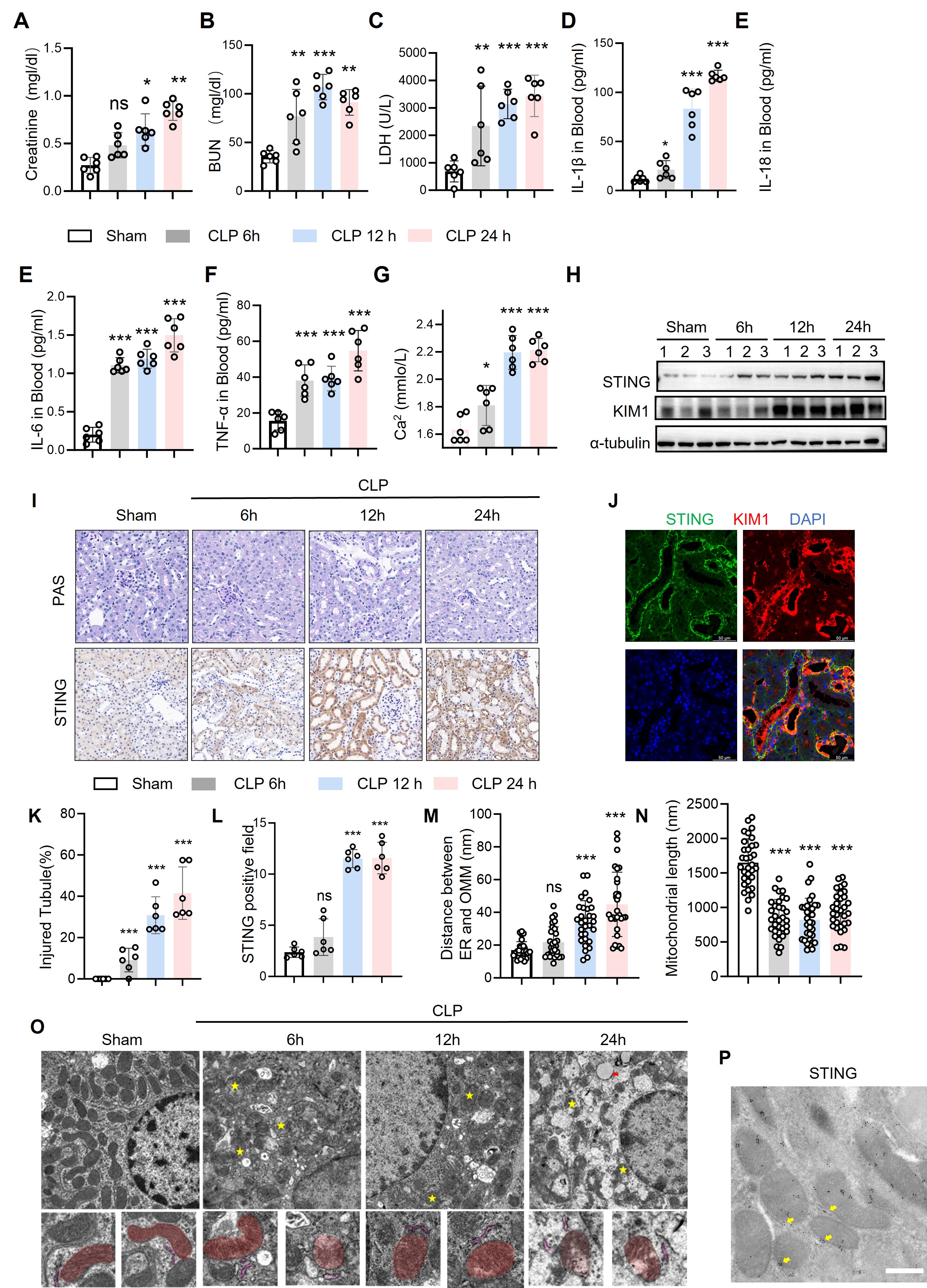
Figure1 

(A–C) Serum levels of creatinine, blood urea nitrogen (BUN), and lactate dehydrogenase (LDH) in mice subjected to cecal ligation and puncture (CLP) for 6, 12, or 24 h, compared with sham-operated controls (n = 8 per group).

(D–F) Circulating proinflammatory cytokines IL-1β, IL-6, and TNF-α were significantly elevated in CLP-induced sepsis compared with sham controls (n = 6–8).
(G) Serum calcium concentration was increased following CLP, indicating systemic calcium imbalance during sepsis (n = 8).
(H) Representative immunoblots showing time-dependent upregulation of STING and KIM-1 in kidney tissues from CLP mice at 6–24 h; α-tubulin served as a loading control.
(I) Periodic acid–Schiff (PAS) staining showing progressive tubular damage and STING immunohistochemical staining demonstrating increased tubular expression over time after CLP.
(J) Immunofluorescence staining for STING (green) and KIM-1 (red) showing colocalization in injured tubular segments; nuclei are counterstained with DAPI (blue).
(K–L) Quantification of tubular injury and STING-positive areas in kidney sections (n = 6).
(M–N) Transmission electron microscopy (TEM) analyses of renal tubular cells showing an increased distance between ER and outer mitochondrial membrane (OMM) and shortened mitochondrial length after CLP (n = 40–50 mitochondria per group).
(O) Representative TEM micrographs showing progressive mitochondrial cristae disruption and ER swelling in renal tubules at 6–24 h post-CLP; yellow asterisks mark MAM regions; lower panels highlight segmented mitochondria (pseudo-colored red).
(P) Immunogold electron microscopy confirming the localization of STING (yellow dots) at mitochondria-associated membranes (MAMs).

Data are presented as mean ± SEM; ns, not significant; *p < 0.05, **p < 0.01, ***p < 0.001, ****p < 0.0001 vs. sham (one-way ANOVA with Tukey’s post hoc test). Scale bars: (I, J) 50 μm; (O) 500 nm; (P) 200 nm.


Figure2 
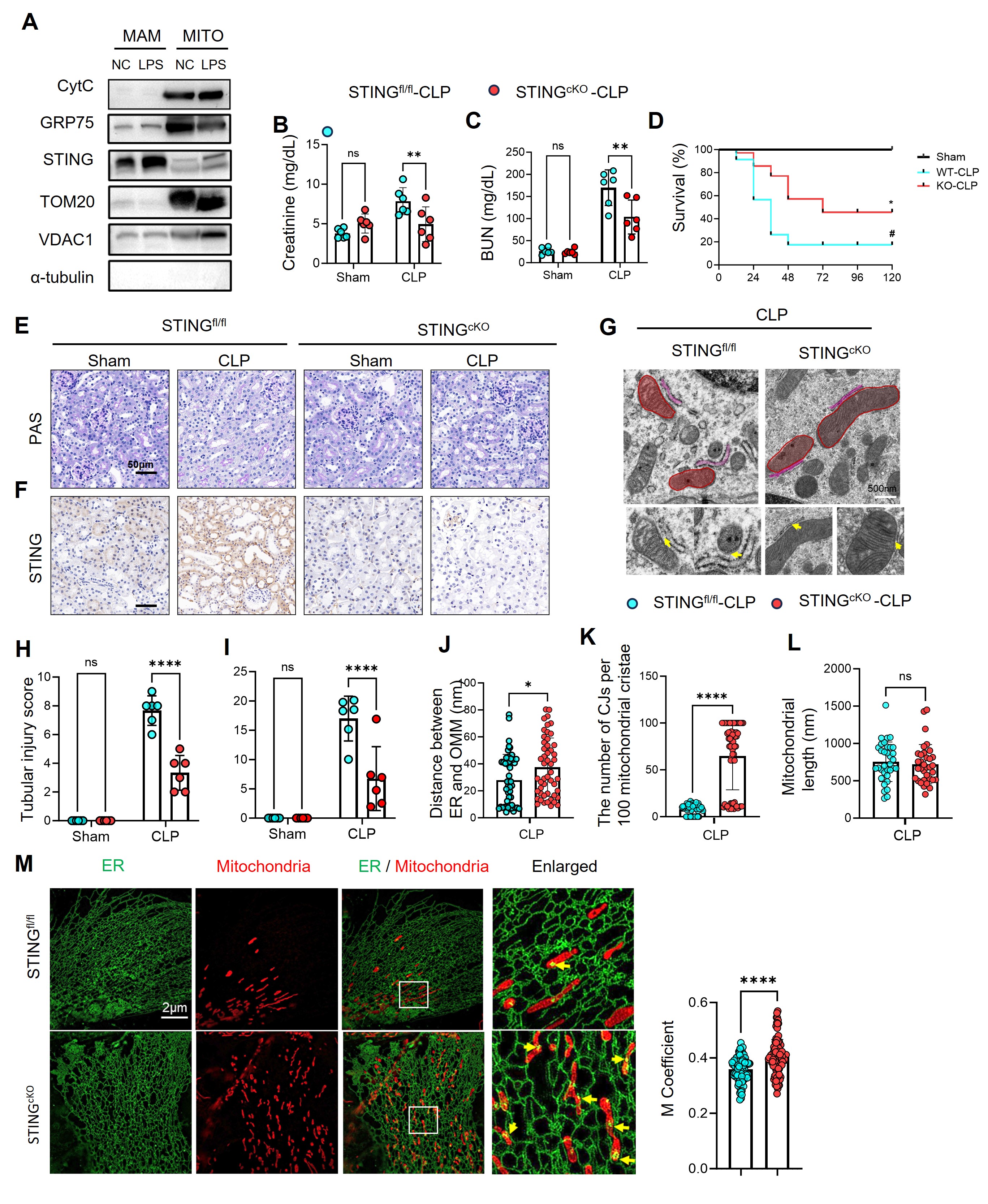
(A) Western blot analysis of subcellular fractions from mouse renal tubular cells showing STING enrichment in mitochondria-associated membranes (MAMs) and mitochondria (MITO) after LPS stimulation. GRP75 and TOM20 were used as MAM and mitochondrial markers, respectively.
(B–C) Serum creatinine and blood urea nitrogen (BUN) levels in STING^fl/fl and STING^CKO mice subjected to CLP or sham surgery (n = 6 per group).
(D) Kaplan–Meier survival curves demonstrating improved survival of STING^CKO mice compared with STING^fl/fl controls following CLP (n = 10 per group, log-rank test).
(E–F) Representative PAS and STING immunohistochemical staining of kidney sections from STING^fl/fl and STING^CKO mice 24 h after CLP, showing reduced tubular damage and attenuated STING expression in knockout mice.
(G) Transmission electron microscopy (TEM) images showing preserved mitochondrial cristae and reduced ER swelling in STING^CKO kidneys; yellow arrows indicate ER–mitochondria contact sites (MAMs). Red pseudocolor highlights mitochondria.
(H–I) Quantification of tubular injury scores and STING-positive area in renal tissues (n = 6).
(J–L) Quantitative ultrastructural analysis showing decreased ER–outer mitochondrial membrane (OMM) distance, increased number of crista junctions (CJs), and restored mitochondrial morphology in STING^CKO kidneys (n = 40–50 mitochondria per group).
(M) HIS-SIM super-resolution imaging of ER (green) and mitochondria (red) in primary tubular epithelial cells from STING^fl/fl and STING^CKO  mice. Merged and enlarged views show enhanced ER–mitochondrial overlap in STING-deficient cells. The right panel quantifies Manders’ colocalization coefficient, indicating restoration of MAM integrity in STING^KO cells (n = 50 cells).

Data are shown as mean ± SEM; ns, not significant; *p < 0.05, **p < 0.01, ****p < 0.0001 versus indicated controls (one-way ANOVA or t-test as appropriate). Scale bars: (E–F) 50 μm; (G) 500 nm; (M) 2 μm.


1. STING Activation Correlates with Renal Damage in S-AKI

In the CLP model, WT mice exhibited severe renal dysfunction, elevated serum creatinine and BUN, and marked tubular necrosis. Immunofluorescence revealed that STING expression was significantly increased in proximal tubular epithelial cells and colocalized with the injury marker KIM-1. In contrast, STING⁻/⁻ mice showed preserved tubular architecture, lower levels of inflammatory infiltration, and improved seven-day survival. These data indicate that STING activation aggravates tubular injury during sepsis.

2. STING Localizes to MAMs and Disrupts ER–Mitochondrial Communication

Subcellular fractionation confirmed STING enrichment in the MAM compartment, where it co-localized with GRP75 and VDAC1. HIS-SIM imaging demonstrated reduced ER–mitochondrial contact in septic WT cells, whereas STING knockout restored the continuity of MAMs. TEM revealed that loss of STING prevented mitochondrial swelling and preserved cristae integrity. Proteomic profiling further indicated that STING deletion upregulated proteins associated with oxidative phosphorylation and fatty acid oxidation, suggesting recovery of mitochondrial metabolic capacity.

3. STING–VDAC1 Interaction Drives Calcium Overload and Pyroptosis

Molecular docking predicted multiple hydrogen-bond interactions between STING and VDAC1, which were experimentally confirmed by Co-IP assays. Mutation of C91A, the palmitoylation site essential for STING membrane localization, disrupted this interaction, whereas mutation of the canonical signaling site (S36A) did not. Overexpression of STING induced excessive mitochondrial calcium accumulation, increased ROS production, and upregulation of pyroptotic markers including NLRP3 and cleaved GSDMD. Silencing of VDAC1 or calcium chelation abolished these effects. In vivo, STING⁻/⁻ mice exhibited significantly reduced mitochondrial calcium levels, lower ROS generation, and attenuated pyroptosis, confirming that STING–VDAC1 coupling mediates calcium-dependent cell death.

We identify the STING–VDAC1 axis at MAMs as a pivotal driver of mitochondrial calcium overload and pyroptotic cell death in sepsis-associated acute kidney injury. STING translocation to MAMs disturbs ER–mitochondrial communication, leading to energy failure and organ dysfunction. Targeting the STING–VDAC1 interface restores mitochondrial homeostasis and offers a novel organelle-level therapeutic strategy for S-AKI and potentially other inflammation-driven metabolic diseases.

Kewords