DOUBLE FILTRATION PLASMAPHERESIS EXPERIENCE: A CASE SERIES IN A THIRD LEVEL HOSPITAL IN COLOMBIA


Certificate Output Instructions

For best output, select "Paper Size" as "A4" and "Margin" as "0" or "None".

To save or print to PDF, please select Print Destination > Save as PDF, enable Background Graphics under "More Settings", then click "Save".


Certificate Background


Presented the abstract " "
(Abstract co-author(s):  )


E-Poster Presentation

During the congress, E-Posters will be accessible to all participants on the congress website 24/7, as well as in the E-poster stations in the congress center. 

Preparing your E-Poster

Please review the E-Poster format requirements carefully when preparing your E-Poster. Should your E-Poster not meet the mentioned requirements, it may not be displayed as described above.

​E-Poster Submission Deadline

Please prepare and upload your E-Poster no later than March 14, 2026 11.59PM CET. After this date, you will no longer be able to prepare and upload your E-poster and it will not be displayed and accessible on the congress website.​

E-Poster Format Requirements
  • PDF file
  • Layout: Portrait (vertical orientation)
  • One page only (Dim A4: 210 x 297mm or PPT)
  • E-Poster can be prepared in PowerPoint (one (1) PowerPoint slide) but must be saved and submitted as PDF file.
  • File Size: Maximum file size is 2 Megabytes (2 MB)
  • No hyperlinks, animated images, animations, and slide transitions
  • Language: English
  • Include your abstract number
  • E-posters can include QR codes, tables and photos
https://storage.unitedwebnetwork.com/files/1099/edb539f2fb7dbd59020c4468dd113b20.pdf
DOUBLE FILTRATION PLASMAPHERESIS EXPERIENCE: A CASE SERIES IN A THIRD LEVEL HOSPITAL IN COLOMBIA

Please follow the instructions below to input your abstract title.

Abstract titles should be brief and reflect the content of the abstract.

  • The title will not be accepted if it exceeds 25 words.
  • Type in CAPITAL LETTERS.
  • Lowercase may be used for abbreviations only, for example, mRNA.
David Serna
Henao
Jhon Serna Flórez jsernaflorez@gmail.com Hospital San Juan De Dios Quindío Armenia Colombia -
Santiago Ortiz Ramírez san9205@hotmail.com Hospital San Juan De Dios Quindío Armenia Colombia -
Juiliana Durán Caicedo julianaduran@gmail.com Hospital San Juan De Dios Quindío Armenia Colombia -
David Serna Henao davidsernahenao@gmail.com Ponticifia Universidad Javeriana Cundinamarca Bogotá D.C Colombia *
Valentina Marín Bedoya valentina.marinb@uqvirtual.edu.co Universidad del Quindío Quindío Armenia Colombia -
-
-
-
-
-
-
-
-
-
-

Double filtration plasmapheresis (DFPP) is a procedure that allows for the selective clearance of pathogenic substances from plasma. It can contribute to the treatment of several neurologic, immune, renal and metabolic conditions. Its use in clinical practice has been established by the recommendations of the American Society for Apheresis (ASFA), however much experience and evidence is still needed for its widespread use. To describe the experience and application of DFPP in a third level hospital in the department of Quindio - Colombia (SA) during the years 2024-2025, analyzing its indications, clinical outcomes and complications.

Descriptive observational retrospective study of patients receiving DFPP between the years 2024 and 2025 in a third level hospital in Quindio - Colombia (SA). Different variables were measured and analyzed, including age, sex, clinical diagnosis, indication for DFA and complications. Indications for DFPP were classified according to the ASFA recommendations.

A total of 141 procedures in 27 patients were analyzed. Of the patients included, 15 (55.5%) were women and 12 (44.4%) were men. The mean age was 51 years old, with an age predominance between 40 and 60 years old.

The distribution of indications for DFPP according to the ASFA recommendations were as follows (Chart 1):
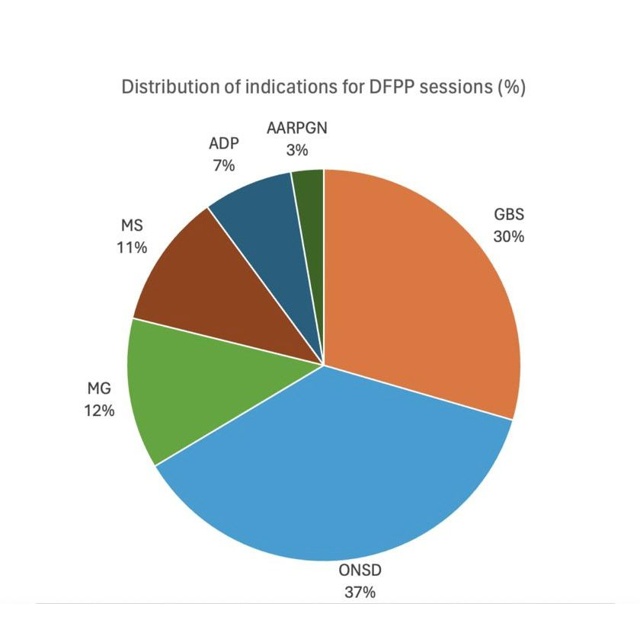
Distribution of indications for DFPP sessions (%)

Category I:

*Guillain-Barré syndrome (GBS) (29,6%)

*Myasthenia gravis (MG) (12,5%)

*Acute demyelinating polyneuropathy (ADP) (7,4%)

*ANCA-associated rapidly progressive glomerulonephritis (AARPGN) (2.7%)


Category II:

*Multiple sclerosis (MS) (11,1%)

*Optic neuritis spectrum disorders (ONSD) (37%)


The reported complications following the procedure were:

*Central line-associated bloodstream infections (25,9%)

*Low serum fibrinogen  < 100 mg/dL (9,2%)

*Clinical hypertension (4,2%)

*Deep vein thrombosis (2,7%)

*Thoracic duct laceration (2,7%)

*Air embolism 2,7%)

*Hypotension-induced seizure (2,7%)

*Central line hemorrhage (2,7%)


Clinical response was evaluated by a certified clinical neurologist according to subjective criteria. There was complete response in 33.3% of patients, partial response in 62.9% of patients, and no response in 2.7% of patients. The overall in-hospital mortality during the study period was 0%.

DFPP performed well as an effective and overall safe procedure, with a predominance of neurologic indications according to the ASFA recommendations. Its deployment contributed to an overall clinical improvement in the majority of treated patients, confirming its value as a novel therapeutic alternative for patients with severe pathologies requiring a multidisciplinary team in high-complexity facilities.

Kewords