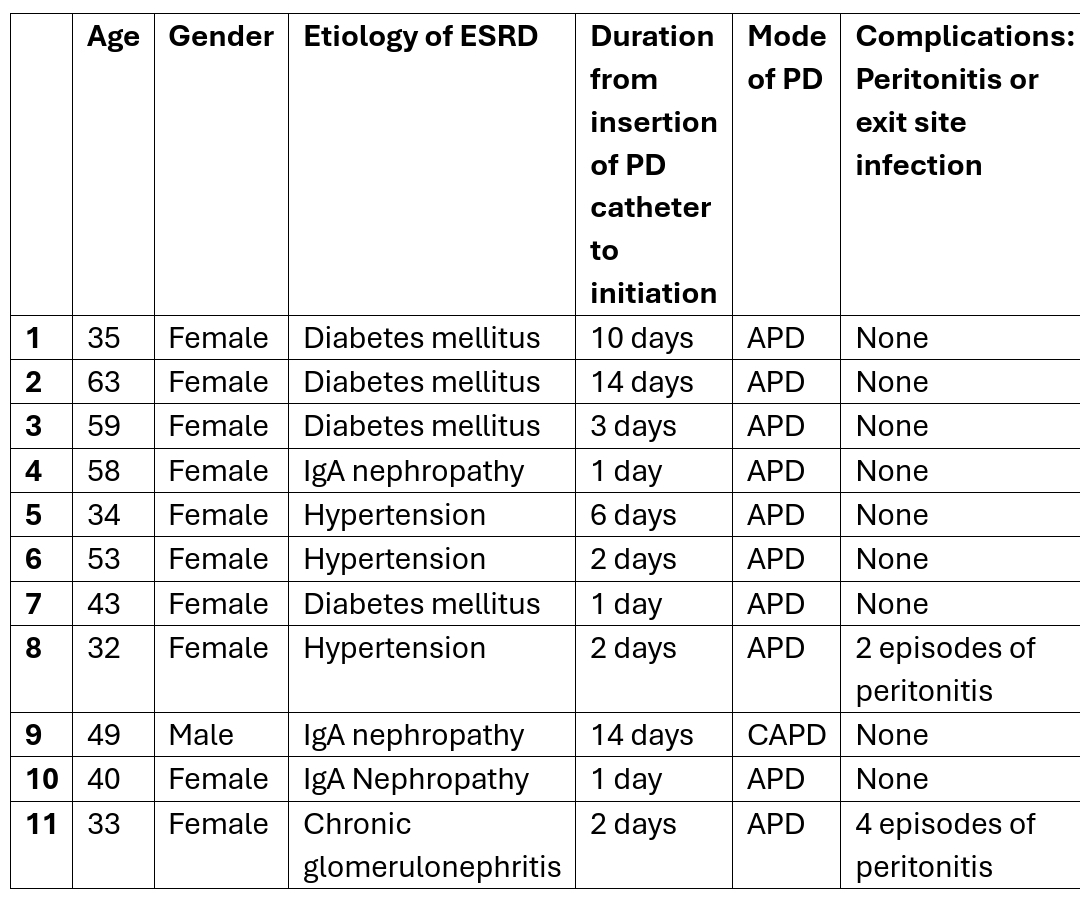
 Urgent start PD USPD is sometimes referred to as ‘acute-start PD’, ‘acute PD’ or ‘early-start PD’is define starting PD within 2 weeks after PD catheter inserion.emergency-start PD’ a term used to characterise PD started emergently within hours on insertion.
USPD historically avoided as International guideline recommended to start PD after 2 weeks of insertion to avoid mechanical complication other reasons is related to lack of experience , familiarity, and some logistical difficulties. However USPD become more popular in sitting of resources shortage in particular at covid pandemic.In general patient who is candidate to conventional PD he is suitable for USPD .it can be an option for both ESRD as PD chronic modality or as temporary in AKI.
Important factor play role in selection between USPD or HD is resources availability in some centers median days needed to arrange for cathter insertion is about 2-6 days in acute sitting a sick patient can not wait therefore HD started at earlier time.
Contraindications either absolute or relative for USPD are in general is similar to conventional PD. However patient needs emergency RRT due to life threatening condition like sever hyperkalmia or sever volume overload USPD should be avoided ,HD consider better option where rapid , accurate solute clearance and adequate ultrafiltration needed.
Good functioning access is the main step in successful USPD. Patient should be prepared, however due to urgent situations and need to act fast optimal preparation may be limitted .but whenever the time allowed preparation should include mapping the exit site , bowel preparation to avoid constipation, and emptying the bladder to avoid bladder injury.
The procedure should be performed in complete sterile percussion. It can be performed bed side, in a fluoroscopy suite or operating theatre depending on local protocol and experience. Prophylactic antibiotics highly recommend pre-procedure.
In regards to type of catheter in general there are two type of PD catheter rigid non cuffed catheter and flexible chuffed catheter .
The rigid catheter is usually straight and non cuffed it can be performed at bed side they are temporary can be used for few days .they associated with high rate of peritonitis, there use nowadays is less unless in sitting resources are limited and life saving dialysis needed.
The tunnelled cuffed PD catheter is preferred on rigid catheter they made of silicone plastic nowadays more widely available and more importantly less complications and better function.There is different catheter designs are used however in general none shown to be superior on the others.
There is different technique for insertion including percutaneous ,open surgery ,or laparoscopy insertion .there is no difference in clinical outcomes between any of thes techniques. In real practice the main factor increase successful rate of insertion is local clinical experience. however percutaneous technique may associated with improved cost-effectiveness and logistical efficiency.
The catheter insertion can be performed either by surgeon , interventional radiology or nephrologists Outcomes are comparable across all, the successful mainly depends on experience.
Initial starting dialysis prescription should be gentle and balanced to avoid any initial complication .the prescription depends on the clinical context, body size and the degree of residual renal function.
The main concern is pericathter dialysate leak this can be decreased by reducing intra abdominal pressure with low indwelling volume while patient in supine position . However this may be challenging in patient starting on USPD particularly when they require faster action greater precision, and higher effective clearance
Other components of PD prescription includes number and duration of exchange ,PD dwell volume and solution tonicity this can be adjusted and individualised based on net filtration needed and solute clearance depending on patient clinical condition.
Either CAPD or APD can be performed as PD modality . and both techniques gives similar outcomes in USPD. However ADP is preferred method once available as its more convenient and associated with less risk of peritonitis.adequate USPD can be assessed based on clinical features, biochemical markers which can be helpful guide in dialysis adequacy .In general at least 1000 ml of ultrafiltration daily in anuric patient considered adequate and require around 10 L dialysate per day
Since patient newly initiated PD still has good residual renal function, therefore no need for intensive dialysis prescription. Accordinglly incremental start PD is an ideal approach for example 3 to 4 exchange low volume for CAPD ,and 6 to 8 hours overnight for APD with short low volume cycles. Dwell volume depends on body size however usually around 1 L most of the time and to use low tonicity solution .in general the ideal prescription in USPD should be individualised based on patient and case by case.
The USPD prescription in AKI patient is different the purpose in the management is to obtain fast stabilisation of electrolytes, acid-base balance and fluid status. This required more aggressive dialysis prescription higher dwell volumes , more frequency and higher fluid tonicity. Loop diuretics also can be added to help in optimization of fluid status.
Daily patient monitoring is mandatory and dialysis prescription can be adjusted accordingly .in addition to clinical condition biochemical laboratory needs monitoring as well. In sitting patient clinical conditions not improving transient HD may needed .
The main concern for USPD is increased risk of early mechanical complications in particular peri-catheter leak.
In one study it showed risk of leak is higher than conventional PD .however in other retrospective studies has not been shown increase in peri catheter leak.On other hand USPD compared to conventional PD did not show increase incidence of catheter obstruction, migration, malposition, or need for catheter readjustment, nor poor effluent drainage, exit site infection, peritonitis, or bleeding .however, the risk of infection may be higher in the presence of dialysate leak
There is no sufficient data to compare USPD versus HD a systematic review of 7 cohort studies reported equivalent technique survivals , furthermore USAP appears to be cheaper.
In order to develop successful USPD program this require MDT collaboration including administrative support. The main obstacles is timely placement of a PD catheter once needed . This need well dictated team available on time once called . although the surgeon usually perform the catheter insertion. But several centre reported improve in USPD once the procedure performed by good experience nephrologist who can perform PD catheter insertion percutaneous at bed side this reduce the time for surgical consultations and the need or availability of operation room.USPD programme include nursing support, patient education, deliberate infrastructure, multi-specialty team collaboration and surgical backup for complex cases, and clear protocols.
