PARADOXICAL ASSOCIATION OF BLOOD PRESSURE WITH CHRONIC KIDNEY DISEASE STAGES


Certificate Output Instructions

For best output, select "Paper Size" as "A4" and "Margin" as "0" or "None".

To save or print to PDF, please select Print Destination > Save as PDF, enable Background Graphics under "More Settings", then click "Save".


Certificate Background


Presented the abstract " "
(Abstract co-author(s):  )


E-Poster Presentation

During the congress, E-Posters will be accessible to all participants on the congress website 24/7, as well as in the E-poster stations in the congress center. 

Preparing your E-Poster

Please review the E-Poster format requirements carefully when preparing your E-Poster. Should your E-Poster not meet the mentioned requirements, it may not be displayed as described above.

​E-Poster Submission Deadline

Please prepare and upload your E-Poster no later than March 14, 2026 11.59PM CET. After this date, you will no longer be able to prepare and upload your E-poster and it will not be displayed and accessible on the congress website.​

E-Poster Format Requirements
  • PDF file
  • Layout: Portrait (vertical orientation)
  • One page only (Dim A4: 210 x 297mm or PPT)
  • E-Poster can be prepared in PowerPoint (one (1) PowerPoint slide) but must be saved and submitted as PDF file.
  • File Size: Maximum file size is 2 Megabytes (2 MB)
  • No hyperlinks, animated images, animations, and slide transitions
  • Language: English
  • Include your abstract number
  • E-posters can include QR codes, tables and photos
https://storage.unitedwebnetwork.com/files/1099/d680d9c86c5289644629d450816e1aa5.pdf
PARADOXICAL ASSOCIATION OF BLOOD PRESSURE WITH CHRONIC KIDNEY DISEASE STAGES

Please follow the instructions below to input your abstract title.

Abstract titles should be brief and reflect the content of the abstract.

  • The title will not be accepted if it exceeds 25 words.
  • Type in CAPITAL LETTERS.
  • Lowercase may be used for abbreviations only, for example, mRNA.
Ekamol
Tantisattamo
Ekamol Tantisattamo ekamoltan@gmail.com University of California Irvine School of Medicine American Heart Association Comprehensive Hypertension Center at the University of California Irvine Medical Center, Division of Nephrology, Hypertension and Kidney Transplantation, Department of Medicine Orange, California United States * Tibor Rubin Veterans Affairs Medical Center, Veterans Affairs Long Beach Healthcare System Nephrology Section, Department of Medicine Long Beach, California United States Faculty of Medicine Ramathibodi Hospital, Mahidol University Excellent Center for Organ Transplantation Bangkok Thailand
Panchanit Yongkiatkan panchanityk@gmail.com University of California Irvine School of Medicine American Heart Association Comprehensive Hypertension Center at the University of California Irvine Medical Center, Division of Nephrology, Hypertension and Kidney Transplantation, Department of Medicine Orange, California United States -
Natanon Chamnarnphol natanon.c@gmail.com University of California Irvine School of Medicine American Heart Association Comprehensive Hypertension Center at the University of California Irvine Medical Center, Division of Nephrology, Hypertension and Kidney Transplantation, Department of Medicine Orange, California United States -
Sorawis Ngaohirunpat sorawis.ngao@gmail.com University of California Irvine School of Medicine American Heart Association Comprehensive Hypertension Center at the University of California Irvine Medical Center, Division of Nephrology, Hypertension and Kidney Transplantation, Department of Medicine Orange, California United States -
Issaree Boonyawannukul doctorpoundpoundz.fbi@gmail.com University of California Irvine School of Medicine American Heart Association Comprehensive Hypertension Center at the University of California Irvine Medical Center, Division of Nephrology, Hypertension and Kidney Transplantation, Department of Medicine Orange, California United States - Khon Kaen University Faculty of Medicine Srinagarind Hospital Khon Kaen Thailand
Nongnapas Assawamasbunlue nongnapas.assawa@gmail.com University of California Irvine School of Medicine American Heart Association Comprehensive Hypertension Center at the University of California Irvine Medical Center, Division of Nephrology, Hypertension and Kidney Transplantation, Department of Medicine Orange, California United States -
Napat Wongmat napat.6402@gmail.com University of California Irvine School of Medicine American Heart Association Comprehensive Hypertension Center at the University of California Irvine Medical Center, Division of Nephrology, Hypertension and Kidney Transplantation, Department of Medicine Orange, California United States -
Nopavit Mohpichai nopavit.moh@gmail.com University of California Irvine School of Medicine American Heart Association Comprehensive Hypertension Center at the University of California Irvine Medical Center, Division of Nephrology, Hypertension and Kidney Transplantation, Department of Medicine Bangkok United States - Mahidol University Faculty of Medicine Ramathibodi Hospital Bangkok Thailand
Thanasin Chalermchat thanasin.cha@student.mahidol.edu University of California Irvine School of Medicine American Heart Association Comprehensive Hypertension Center at the University of California Irvine Medical Center, Division of Nephrology, Hypertension and Kidney Transplantation, Department of Medicine Orange, California United States - Mahidol University Faculty of Medicine Siriraj Hospital Bangkok Thailand
Darinorn Pleanrungsi darinorn.ple@student.mahidol.edu University of California Irvine School of Medicine American Heart Association Comprehensive Hypertension Center at the University of California Irvine Medical Center, Division of Nephrology, Hypertension and Kidney Transplantation, Department of Medicine Orange, California United States - Mahidol University Faculty of Medicine Siriraj Hospital Bangkok Thailand
Katanyu Siwawut katanyu.siw@student.mahidol.edu University of California Irvine School of Medicine American Heart Association Comprehensive Hypertension Center at the University of California Irvine Medical Center, Division of Nephrology, Hypertension and Kidney Transplantation, Department of Medicine Orange, California United States - Mahidol University Faculty of Medicine Siriraj Hospital Bangkok Thailand
Thanin Asawaroekwisoot thaninasawaroekwisoot@gmail.com University of California Irvine School of Medicine American Heart Association Comprehensive Hypertension Center at the University of California Irvine Medical Center, Division of Nephrology, Hypertension and Kidney Transplantation, Department of Medicine Orange, California United States -
Chutawat Kookanok chutawat.koo@pcm.ac.th University of California Irvine School of Medicine American Heart Association Comprehensive Hypertension Center at the University of California Irvine Medical Center, Division of Nephrology, Hypertension and Kidney Transplantation, Department of Medicine Orange, California United States - Interfaith Medical Center Department of Medicine Brooklyn, New York United States
Kyunghee Lee hicaru1004@hanmail.net University of California Irvine School of Medicine American Heart Association Comprehensive Hypertension Center at the University of California Irvine Medical Center, Division of Nephrology, Hypertension and Kidney Transplantation, Department of Medicine Orange, California United States - Daegu Veterans Health Service Medical Center Division of Nephrology, Department of Internal Medicine Daegu Korea (Republic of)
Surasak Kantachuvesiri surasak.kan@mahidol.ac.th Faculty of Medicine Ramathibodi Hospital, Mahidol University Excellent Center for Organ Transplantation Bangkok Thailand -

Elevated blood pressure (BP) is associated with increased risk of CKD progression. However, the magnitude of the association is unclear. We aim to examine the association of systolic and diastolic BP (SBP and DBP) with and CKD stage in U.S. representative population.

A retrospective cross-sectional study using the 2017 - 2020 NHANES database included participants with ≥1 BP measurement. The association of the quartile (Q) of SBP and DBP with CKD stages (stages 1, 2, 3a, 3b, 4, and 5) stratified by self-reported diabetes mellitus (DM) were examined by multiple ordered logistic regression analyses.

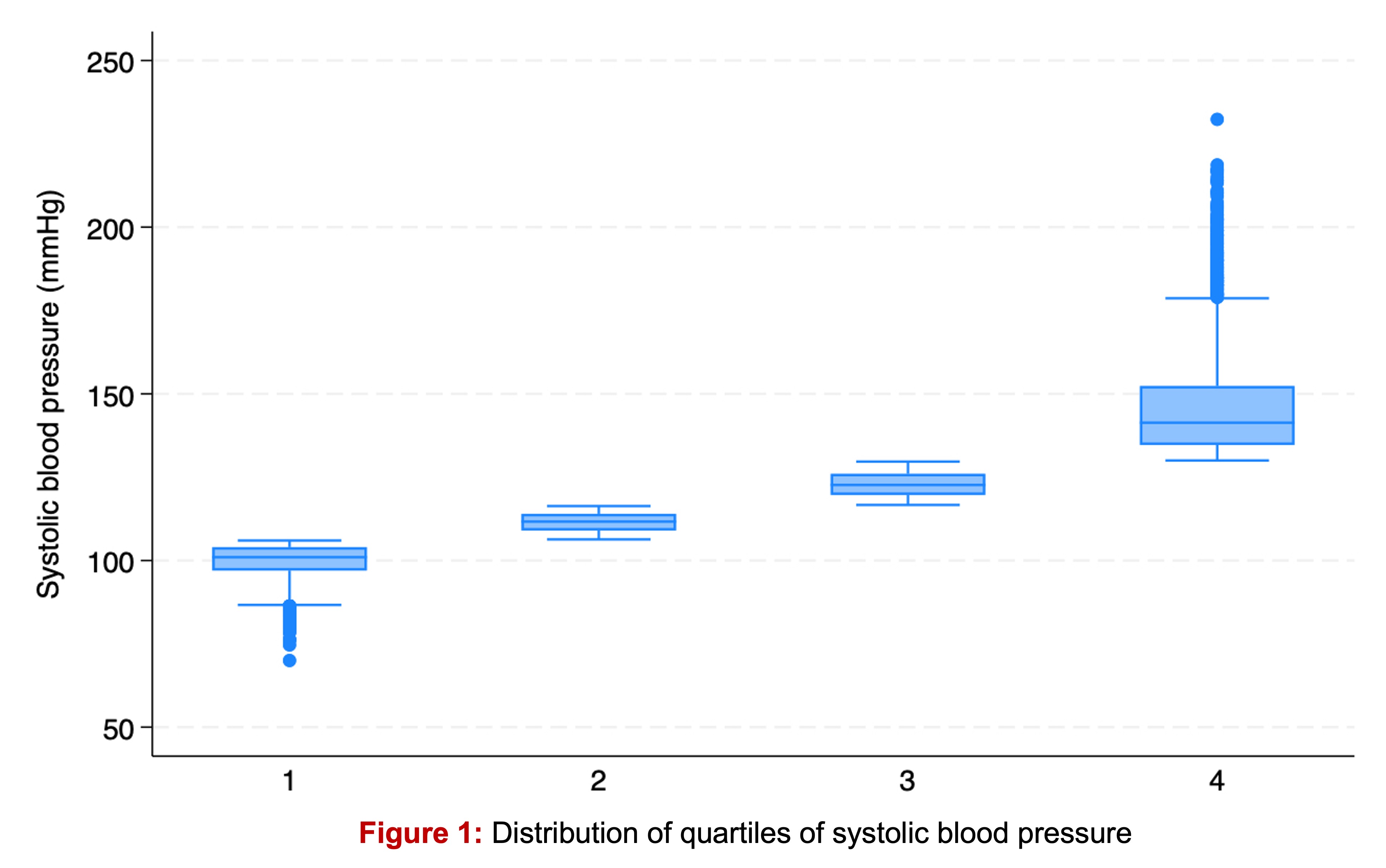
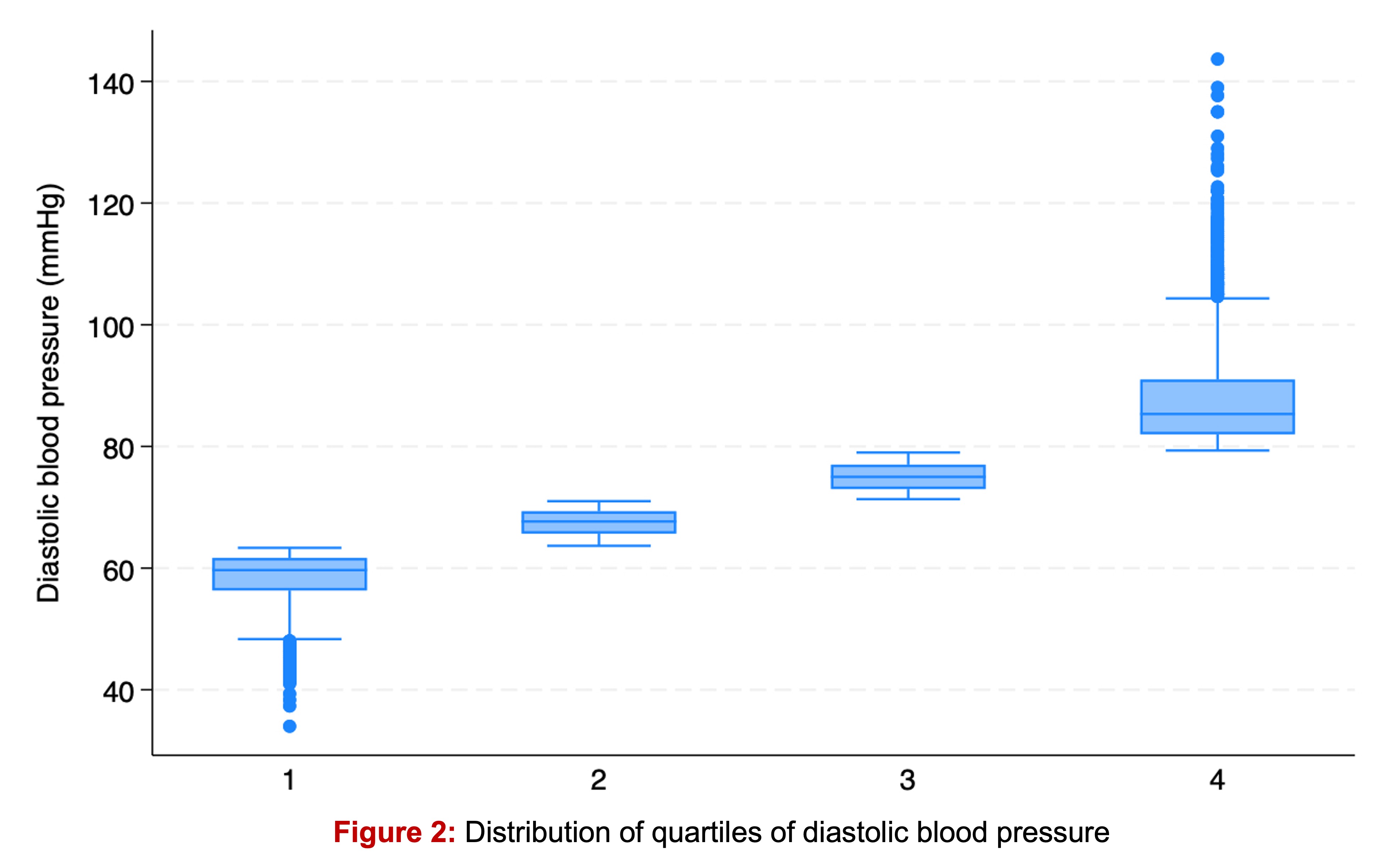
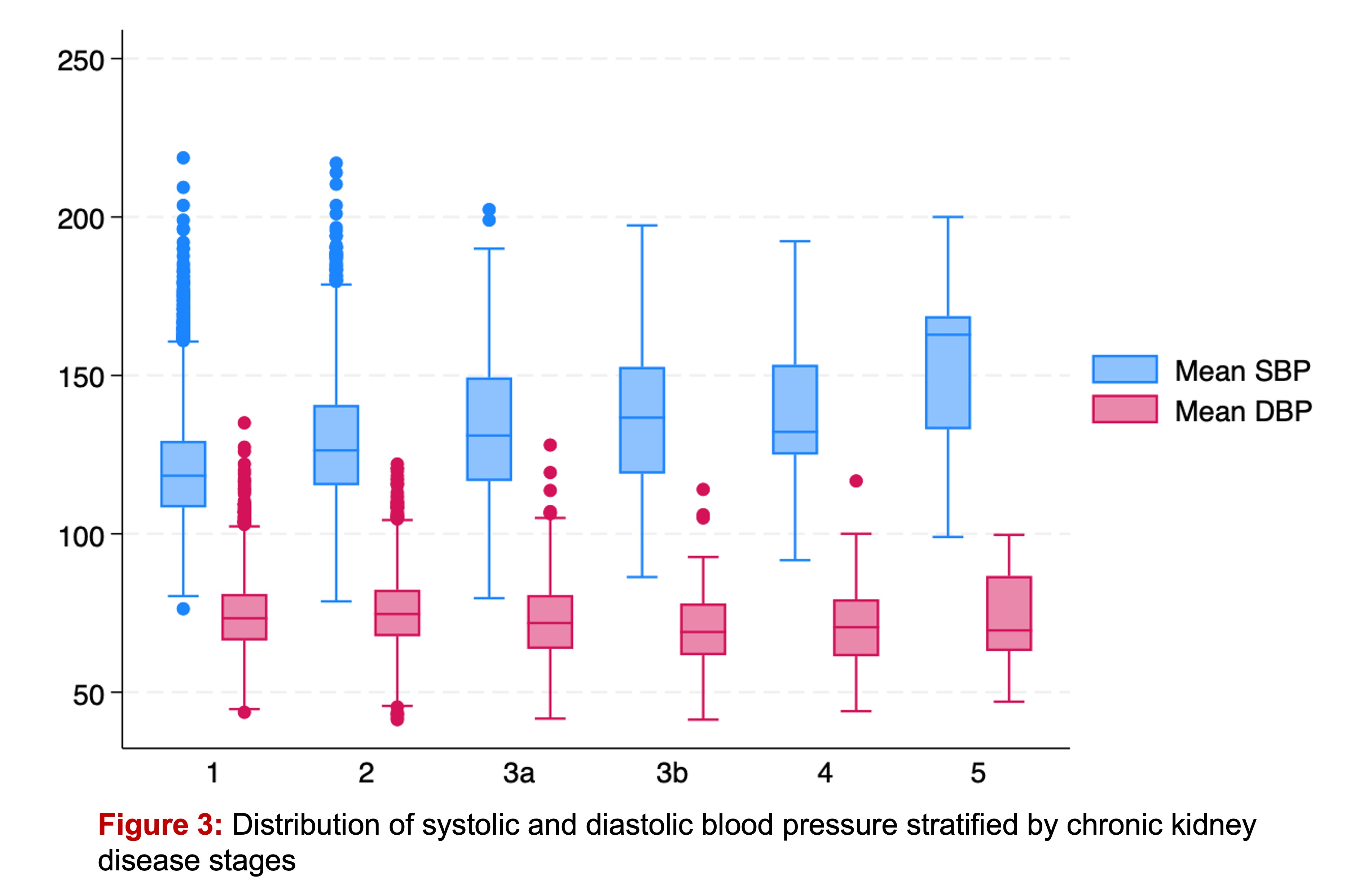
Of 17,846 adult participants ≥18 years old, the mean age+/-SD was 50.75804±18.62576 years and 53.07% were female. Mean SBP and DBP were 123.437±18.78356 and 74.3758±11.36866 mmHg, respectively. Median SBP (IQR) of Q1-Q4 were 101 (97, 104), 112 (109, 114), 123 (120, 126), and 141 (135, 152), respectively (Ptrend <0.0001, Figure 1). Median DBP (IQR) of Q1-Q4 were 60 (56, 62), 68 (56, 69), 75 (73, 77), and 85 (82, 91), respectively (Ptrend <0.0001) (Figure 2). Up to 36.63% and 13.99% ever been diagnosed with hypertension and diabetes, respectively. Participants with hypertension had significantly higher SBP and DBP compared to their non-hypertensive counterparts (SBP 132±20 vs. 119±16; mean±SEMdiff 14±0.31 mmHg and DBP 77±13 vs. 73±10, meandiff 5±0.26). Median eGFR was 98 mL/min/1.73 m2 (80, 112). Distribution of SBP and DBP stratified by CKD stages were shown in Figure 3. Compared to participants with Q1 of SBP, there was positively graded association of the odds of higher CKD stages versus the combined lower CKD stages in participants with Q2, 3, and 4 of SBP (ORSBP-Q2 1.289774, 95%CI 1.087535, 1.529623, P 0.003; ORSBP-Q3 1.784739, 95%CI 1.520853, 2.094413, P <0.0001; ORSBP-Q4 3.781916, 95%CI 3.238689    4.416259, P <0.0001). The association between Q of DBP and CKD stages was in the opposite direction and no significance (DBP: ORDBP-Q2 0.8669494, 95%CI 0.7484288, 1.004239, P 0.057; ORDBP-Q3 0.8761226, 95%CI 0.7592342, 1.011007, P 0.070; ORDBP-Q4 0.9685971, 95%CI 0.8428106, 1.113157, P 0.653). After adjusting for age, gender, race, ethnicity, body mass index, diabetes, hypertension, and hyperlipidemia status, HbA1c, mean SBP or DBP, total cholesterol, urinary microalbumin:urinary creatinine ratio, serum albumin, serum ferritin, high-sensitivity C-reactive protein, level of education, and the ratio of family income to poverty, the SBP quartile – CKD stage association were negatively graded association and significantly only in Q3 and 4 (aORSBP-Q2 0.8446179, 95%CI 0.6746448, 1.057415, P 0.141; aORSBP-Q3 0.722273, 95%CI 0.574752, 0.9076582, P 0.005; aORSBP-Q4 0.6059975, 95%CI 0.4671448, 0.7861224, P <0.0001). There were significantly lower the odds of worsening CKD stage only in Q4 of DBP in fully adjusted model (aORDBP-Q2 0.8544037, 95%CI 0.7004753, 1.042158, P 0.121; aORDBP-Q3 0. 8209054, 95%CI 0.6699415, 1.005887, P 0.057; aORDBP-Q4 0.771907, 95%CI 0.6140594, 0.9703302, P 0.027).

.

.

.

SBP and DBP were inversely associated with CKD stages. This paradoxical relationship may be related to renal hemodynamics, and further longitudinal studies are required.

Kewords