STRUCTURE AND ECONOMICS OF NEPHROLOGISTS AND PRIMARY CARE PHYSICIANS’ COLLABORATION CARE MODEL FOR PERITONEAL DIALYSIS: A SINGLE CENTER EXPERIENCE


Certificate Output Instructions

For best output, select "Paper Size" as "A4" and "Margin" as "0" or "None".

To save or print to PDF, please select Print Destination > Save as PDF, enable Background Graphics under "More Settings", then click "Save".


Certificate Background


Presented the abstract " "
(Abstract co-author(s):  )


E-Poster Presentation

During the congress, E-Posters will be accessible to all participants on the congress website 24/7, as well as in the E-poster stations in the congress center. 

Preparing your E-Poster

Please review the E-Poster format requirements carefully when preparing your E-Poster. Should your E-Poster not meet the mentioned requirements, it may not be displayed as described above.

​E-Poster Submission Deadline

Please prepare and upload your E-Poster no later than March 14, 2026 11.59PM CET. After this date, you will no longer be able to prepare and upload your E-poster and it will not be displayed and accessible on the congress website.​

E-Poster Format Requirements
  • PDF file
  • Layout: Portrait (vertical orientation)
  • One page only (Dim A4: 210 x 297mm or PPT)
  • E-Poster can be prepared in PowerPoint (one (1) PowerPoint slide) but must be saved and submitted as PDF file.
  • File Size: Maximum file size is 2 Megabytes (2 MB)
  • No hyperlinks, animated images, animations, and slide transitions
  • Language: English
  • Include your abstract number
  • E-posters can include QR codes, tables and photos
https://storage.unitedwebnetwork.com/files/1099/0f0bc60ab57534f03501fe54ea5921e6.pdf
STRUCTURE AND ECONOMICS OF NEPHROLOGISTS AND PRIMARY CARE PHYSICIANS’ COLLABORATION CARE MODEL FOR PERITONEAL DIALYSIS: A SINGLE CENTER EXPERIENCE

Please follow the instructions below to input your abstract title.

Abstract titles should be brief and reflect the content of the abstract.

  • The title will not be accepted if it exceeds 25 words.
  • Type in CAPITAL LETTERS.
  • Lowercase may be used for abbreviations only, for example, mRNA.
Hidetoshi
Kanai
Hidetoshi Kanai kanai8140002@yahoo.co.jp Kokura Memorial Hospital Nephrology Fukuoka Japan *
Kenji Harada kenkenharada19790531@yahoo.co.jp Kokura Memorial Hospital Nephrology Fukuoka Japan -
Kuljinder Singh kuljinder.singh@vantive.com Vantive Medical Affairs Tokyo Japan -
Sonia Zeggar sonia.zeggar@vantive.com Vantive Medical Affairs Tokyo Japan -
-
-
-
-
-
-
-
-
-
-
-

As of 2022, home dialysis patients, including Peritoneal Dialysis (PD), accounted for only 3.2% of all dialysis patients, which is the lowest level even in developed countries.

Medical cooperation is a system of collaboration between primary care physicians (PCPs) and nephrological institutions, consisting of nephrologists and multidisciplinary care teams. But much of the focus has been on PCPs and nephrologist collaboration in the early stages of chronic kidney disease (CKD) but less is known about the co-management of the patients in the end-stage of renal disease and dialysis. Since 2010, PD reimbursement fees have been optimized and revised positively, making the public reimbursement higher for PD than for HD


Figure 1:Evolution of public reimbursement fees for PD and HD

Figure 1Evolution of public reimbursement fees for PD and HD

We describe our experience of growing a sustainable PD program and revenues through a medical collaboration model between the PD team consisting of nephrologists, nurses, dieticians, pharmacists, social workers, physical therapists, psychologists, using teamwork approach, and PCPs from 2005 to 2024 at Kokura Memorial Hospital (KMH). Up to 2004, there were no PD patients in our hospital, in 2005 the department of Nephrology initiated a new PD program for the treatment of end-stage kidney disease, and the following steps were taken to build the medical collaboration program with PCPs to grow Peritoneal dialysis.

 1.     CKD Prevention Collaboration System: We repeatedly held study sessions with PCPs, explaining about CKD and the importance of early referrals emphasizing that the patient will be reverse referred to the PCP along with advice on examinations and treatment policies as specialists (Figure 1). Thus, 2 to 3 years after the study sessions began, early and timely referrals began to be received by our hospital.
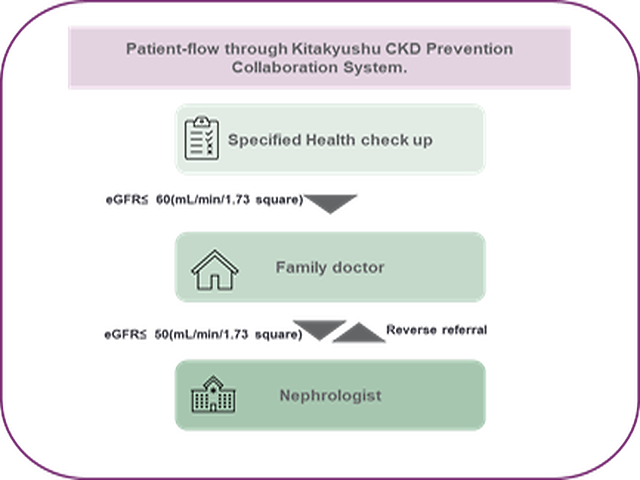
             Kitakyushu City CKD Prevention Collaboration System                                                 

        Figure 1: Kitakyushu City CKD Prevention Collaboration System                           

 2.     Increasing Enrollment of Patients to PD Program through education and awareness: at our center, all CKD patients are referred to pre-ESRD education classes regardless of their CKD stage. A teamwork based educational approach consisting of nephrologists, nurses, dietician, pharmacist, social worker, physical therapist, psychologist educate and help patients and families understand various treatment options. This allows planned initiation of the appropriate RRT modality. We also developed a PD Initiating Program for patients as early as CKD stage 4 with an eGFR<30, that englobes education about different RRT modalities and SDM consultations at different stage until RRT decision, at least 3 SDM consultations by doctors and nurses are planned before admission to start PD or catheter insertion.
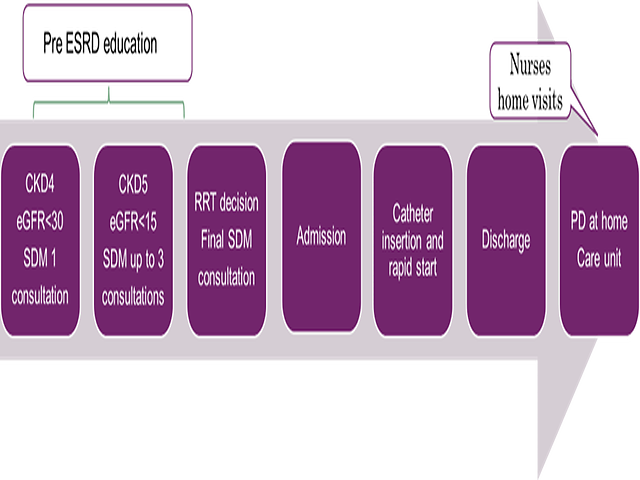
pre-ESRD patient education and PD Initiating Program at KMH

 Figure 2: pre-ESRD patient education and PD Initiating Program at KMH

    3.     Nephrologists/ PCPs PD collaboration: as the number of patients grew, a PD collaboration model was created and started as the next step. Unlike HD where the patient is managed in the dialysis clinic, PD patient can be managed by the PCP, due to different incentive and reimbursement policies, resulting in referrals spurred in the early CKD stage to our hospital and growth of PD patients.

 This cooperation system includes PCPs education programs and seminars, study sessions and conferences, explanations of patient centric care, advantages of PD from an economic standpoint and PD reimbursement system.

 PCP’s role was clearly defined, consisting of a bimonthly patient visit that includes a weight check, amount of fluid removed, salt and fluid intake status, infection prevention with exit site check and blood test prescription and check, with the reassurance of hospital availability 24h/7day in case of emergency or when the PD prescription needs adjustment. The patients still need to visit our facility once every three months for regular checkups, for PET biannually and for transfer set. In addition, during these visits we also reviewed dialysis prescriptions, and staff members re-educated patients, their families and their support persons regarding PD, and examined cardiovascular diseases non-invasively.
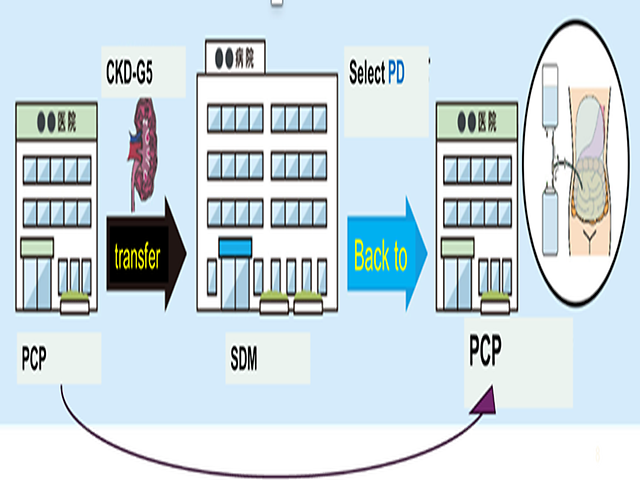
 PCPs and Nephrologists collaboration model in PD

Figure 3: PCPs and Nephrologists collaboration model in PD


We were able to grow our PD program to 320 PD patients making us one of the largest PD centers in Japan, with a 40% PD selection rate, and only 5 patients on maintenance HD at our hospital. By increasing the number of PD patients in the outpatient department rather than increasing the scale of HD, we were able to reduce various HD associated costs such as equipment depreciation costs, the number of staff required for outpatient management, need for overtime pay for nocturnal dialysis . This resulted in increased outpatients-based revenues and annual revenue.

PD patients with PD revenue growth over the years

Figure 1A: PD patients with PD revenue growth over the years

Since PD is a home-based therapy, it does not require additional investment in equipment, facility space, healthcare resources, making it a RRT with a low break-even point. We were able to increase our annual gains steadily, making the outpatients’ revenue account for nearly 50% of our revenue from the department.

 Revenue growth over the years

Figure 1B: Revenue growth over the years

 We were able to grow our PD program and revenues by collaborating with PCPs, to avoid staff burden in the Nephrology department. Over the years, we expanded our medical collaboration system which includes 23 PCPs clinics, 13 home-visiting PCPs, 26 hospitals, 35 home visit nurse stations, more than 30 nursing care facilities, recovery and convalescence hospitals. When the patient is in day care, a single bag change can reduce the burden on the family. Currently, five facilities in the Kokura northern and Southern district are capable of PD treatment through day care.

Partner facilities in collaboration for PD care as of 2025

Figure 1C: Partner facilities in collaboration for PD care as of 2025

The development of a successful PD program requires a transformation from a process organized around an individual physician to a multidisciplinary/medical collaboration care model, that involves an effective collaboration between PCPs and nephrologists, consisting of a comprehensive follow-up program, and continuous communication and information sharing. Medical cooperation system between PCPs and Nephrological institutions supported by revised reimbursement fees can enable sustainable and financially viable growth of PD program. 

Kewords