EFFICACY AND SAFETY OF DAPAGLIFLOZIN IN PRESERVING RESIDUAL URESIS IN PATIENTS STARTING PERITONEAL DIALYSIS AT THE HOSPITAL REGIONAL ISSSTE PUEBLA


Certificate Output Instructions

For best output, select "Paper Size" as "A4" and "Margin" as "0" or "None".

To save or print to PDF, please select Print Destination > Save as PDF, enable Background Graphics under "More Settings", then click "Save".


Certificate Background


Presented the abstract " "
(Abstract co-author(s):  )


E-Poster Presentation

During the congress, E-Posters will be accessible to all participants on the congress website 24/7, as well as in the E-poster stations in the congress center. 

Preparing your E-Poster

Please review the E-Poster format requirements carefully when preparing your E-Poster. Should your E-Poster not meet the mentioned requirements, it may not be displayed as described above.

​E-Poster Submission Deadline

Please prepare and upload your E-Poster no later than March 14, 2026 11.59PM CET. After this date, you will no longer be able to prepare and upload your E-poster and it will not be displayed and accessible on the congress website.​

E-Poster Format Requirements
  • PDF file
  • Layout: Portrait (vertical orientation)
  • One page only (Dim A4: 210 x 297mm or PPT)
  • E-Poster can be prepared in PowerPoint (one (1) PowerPoint slide) but must be saved and submitted as PDF file.
  • File Size: Maximum file size is 2 Megabytes (2 MB)
  • No hyperlinks, animated images, animations, and slide transitions
  • Language: English
  • Include your abstract number
  • E-posters can include QR codes, tables and photos
 
EFFICACY AND SAFETY OF DAPAGLIFLOZIN IN PRESERVING RESIDUAL URESIS IN PATIENTS STARTING PERITONEAL DIALYSIS AT THE HOSPITAL REGIONAL ISSSTE PUEBLA

Please follow the instructions below to input your abstract title.

Abstract titles should be brief and reflect the content of the abstract.

  • The title will not be accepted if it exceeds 25 words.
  • Type in CAPITAL LETTERS.
  • Lowercase may be used for abbreviations only, for example, mRNA.
José Noel
Guzmán
José Noel Guzmán noelguzdam@gmail.com HRP ISSSTE Puebla Nephrology Puebla Mexico *
Kriscia Mariela Hernández doctorakrsher@hotmail.com HRP ISSSTE Puebla Nephrology Puebla Mexico -
Katia Paola Miranda katiapmiranda20@gmail.com HRP ISSSTE Puebla Nephrology Puebla Mexico -
Mariá José Ayala marijo_2001@hotmail.com HRP ISSSTE Puebla Nephrology Puebla Mexico -
Julian Montes J_montesl@hotmail.com HRP ISSSTE Puebla Nephrology Puebla Mexico -
Sergio Victor Perez checopr7@gmail.com HRP ISSSTE Puebla Nephrology Puebla Mexico -
Oscar Alberto Nava oscar14_ugto@hotmail.com HRP ISSSTE Puebla Nephrology Puebla Mexico -
Gabriela Salas iwage.44@gmail.com HRP ISSSTE Puebla Nephrology Puebla Mexico -
Edgar Eduardo Montoya 22edmr@gmail.com HRP ISSSTE Puebla Nephrology Puebla Mexico -
Mariá José González majogfa@gmail.com HRP ISSSTE Puebla Nephrology Puebla Mexico -
José Alberto Astudillo dr.astudillo91@gmail.com HRP ISSSTE Puebla Nephrology Puebla Mexico -
Daniela Areli Castro danielacasher@gmail.com HRP ISSSTE Puebla Nephrology Puebla Mexico -
Sofia Hernández masofiaher74@gmail.com HRP ISSSTE Puebla Nephrology Puebla Mexico -
Manuel Valentin vacman82@outlook.com HRP ISSSTE Puebla Nephrology Puebla Mexico -
Karen Jimarez karenjimarez29@gmail.com Secretaria de Salud Puebla Medicina interna Puebla Mexico -

The treatment of end-stage chronic kidney disease represents a significant clinical and economic challenge in Mexico. Patients starting renal support therapy, such as peritoneal dialysis (PD), face high morbidity and mortality, primarily from cardiovascular causes. In this context, residual uresis, defined as a urine volume greater than 200 ml per 24 hours that a patient produces independently despite being on dialysis, emerges as a crucial prognostic factor. Residual uresis contributes to the elimination of uremic toxins, improves fluid and electrolyte balance, fluid control, lowers blood pressure, and reduces the required dialysis dose, resulting in improved quality of life and survival.

Historically, dialysis patients have been excluded from clinical trials with new drugs, limiting their therapeutic options. This is the case with sodium-glucose cotransporter 2 (SGLT2) inhibitors, such as dapagliflozin. Although these drugs have demonstrated substantial cardiorenal benefits in patients with less advanced CKD, their use in patients starting dialysis is limited and under-researched.

The primary objective of this study was to determine whether dapagliflozin is safe and confers a benefit in preserving residual uresis in patients starting peritoneal dialysis, comparing them with a control group that did not receive the drug, during a three-month follow-up period in the Nephrology Department of the HRP ISSSTE Puebla. The underlying hypothesis was that dapagliflozin, through its mechanisms of glucosuria and natriuresis, could help maintain and even increase urine production, thus mitigating the complications associated with the loss of residual kidney function.

Study Design: A quasi-experimental, prospective, longitudinal, comparative, randomized, open-label study was conducted.

Study Population: A cohort of 32 patients starting peritoneal dialysis was recruited at the ISSSTE Puebla HRP. Patients were randomly assigned to two homogeneous groups:

• Intervention Group (Cases, n=16): They received dapagliflozin 10 mg orally every 24 hours for three months, in addition to their standard PD treatment.

• Control Group (n=16): They received only standard PD treatment without dapagliflozin.

Inclusion and Exclusion Criteria: Patients over 18 years of age with end-stage renal disease starting peritoneal dialysis, who agreed to enter the study and signed informed consent, were included. Patients with active infections, decompensated liver disease, history of hemodialysis, allergy to dapagliflozin or previous use of the drug, pregnancy, and/or breastfeeding were excluded.

Variables and Measurement: The primary variable was the volume of residual uresis (in ml/24 hours), measured at five time points: before the start of dialysis, during hospitalization, and at the first, second, and third months of follow-up. Secondary variables included estimated glomerular filtration rate (eGFR), hemoglobin levels, erythropoietin dose used, and the incidence of adverse effects (peritonitis and infections).

Statistical Analysis: Chi-square tests were used for categorical variables, and independent samples t tests and Mann-Whitney U tests were used to compare the means and medians of residual uresis and other continuous variables between groups

Difference in residual uresis between both groupsBaseline Population Characteristics:

Both groups were comparable at baseline in terms of demographic and clinical characteristics. The mean age was 57 years, males predominated (59.4%), and type 2 diabetes was the primary etiology of CKD in 81.3% of patients. There were no significant differences in baseline erythropoietin use between the groups.

Primary Outcome: 

Significant Increase in Residual Uresis

The analysis revealed a statistically significant difference in residual uresis favoring the dapagliflozin group at all measurement points.

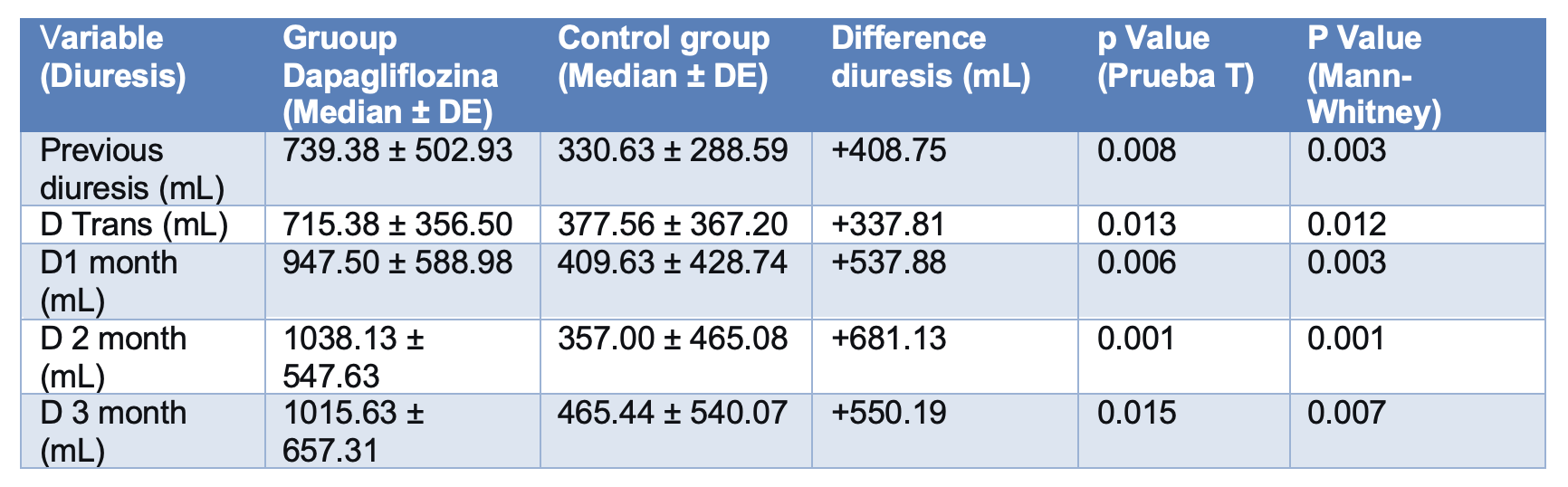
• During Hospitalization: The dapagliflozin group had a mean uresis of 715.38 ± 356.5 ml, compared to 377.56 ± 367.20 ml in the control group. This represents a mean difference of +337.81 ml (p=0.003) in favor of the intervention group from the early stages.

• At Month 1: The gap widened. Mean uresis in the case group was 947.50 ± 588.98 ml, while in the control group it was 409.63 ± 428.74 ml, with a mean difference of +537.88 ml (p=0.003).

• At Month 2: The difference peaked. The dapagliflozin group averaged 1038.13 ± 547.63 ml, versus 357.00 ± 465.08 ml in the control group, representing a mean difference of +681.13 ml (p=0.001).

• At Month 3 (End of Follow-up): Superiority was maintained. The intervention group had a uresis of 1015.63 ± 657.31 ml, compared to 465.44 ± 540.07 ml in the control group, with a mean difference of +550.19 ml (p=0.007).

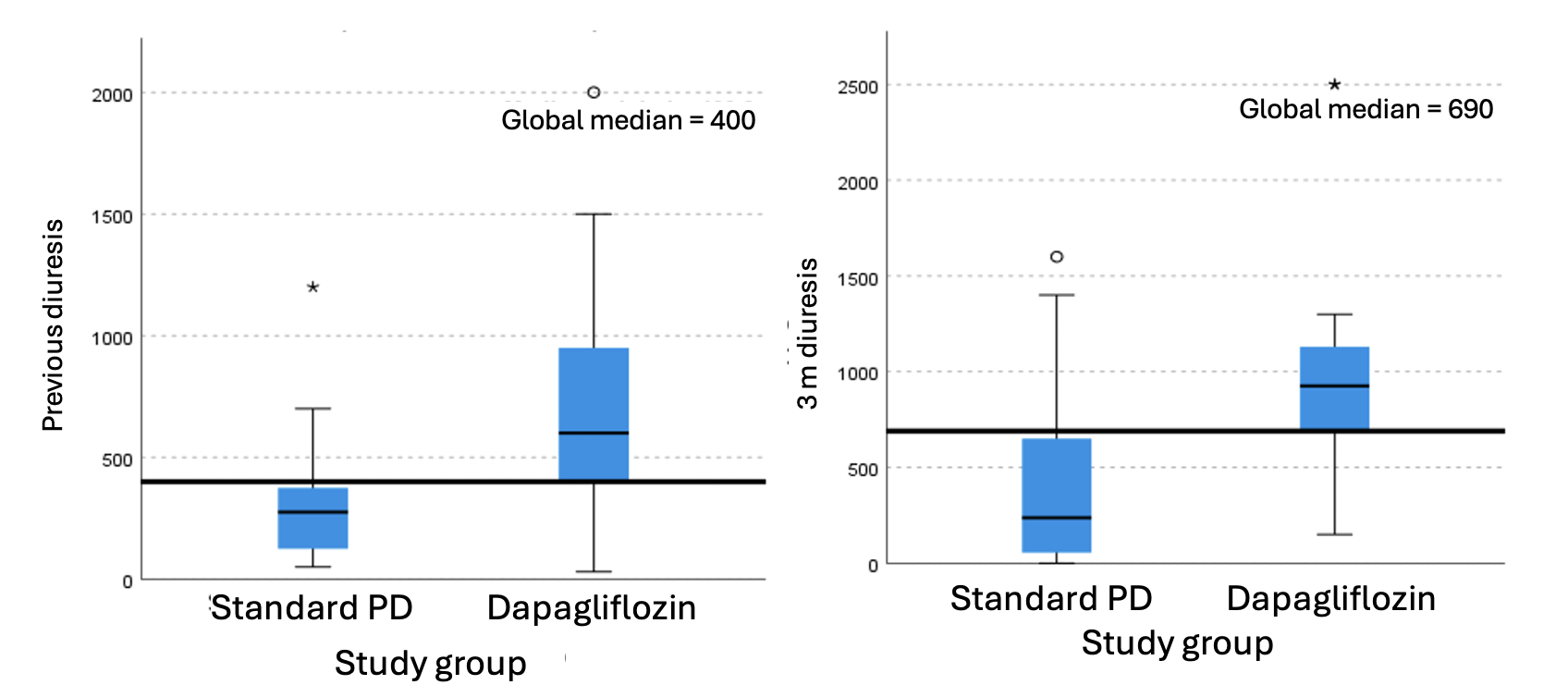
Nonparametric analysis confirmed these findings, reporting a median between-group difference of +585 ml (95% CI: 190–880 ml) in favor of the dapagliflozin group at month 3. These results strongly demonstrate that dapagliflozin not only preserves but significantly increases residual uresis in patients starting peritoneal dialysis.

Secondary Outcomes:

Glomerular Filtration Rate 

A modest and statistically significant improvement was observed only in the first month in the dapagliflozin group (+2.45 ml/min/1.73 m², p=0.013). This difference lost statistical significance in the second and third months, suggesting that the main effect was not on stable eGFR, but on urinary flow.

Hemoglobin and Erythropoietin Use: A trend toward increased hemoglobin was identified in the intervention group at month three (12.03 g/dL vs. 10.58 g/dL), with a difference of +1.45 g/dL, although this difference did not reach statistical significance (p=0.096). There were no significant differences in the dose of erythropoietin used.

Safety and Tolerance: The safety profile of dapagliflozin was excellent. Only one case of peritonitis was recorded in the intervention group (6.25% vs. 0% in the control group, p=1.000), with no significant association. No urinary tract or respiratory infections, episodes of severe hypoglycemia, or ketoacidosis were reported. Drug tolerance was 100%, with no discontinuations due to adverse effects.

This study demonstrates that the administration of dapagliflozin 10 mg daily is an effective and safe intervention for preserving and significantly increasing residual uresis in patients with end-stage chronic kidney disease starting peritoneal dialysis. The primary endpoint was clearly and strongly met, with a sustained benefit observed over the three months of follow-up without an increase in adverse effects, particularly infections with adequate tolerability.

Kewords