We report on
our experience of growing a PD program from 2005 to 2024 at Kokura Memorial
Hospital (KMH). Up to 2004, there were no PD patients, in 2005 the department
of Nephrology initiated a new PD program for the treatment of end-stage kidney
disease, and the following steps were taken to initiate and grow the program:
1 .
CKD education: In Fukuoka Prefecture,
the Kitakyushu City CKD Prevention Collaboration System began in 2010 for early
detection, early diagnosis, timely referral to Nephrologist by PCP and early
treatment of CKD with Nephrologist deciding on either reverse referral or
co-management for each CKD patient with the PCP, as described in Figure 1.
In addition,
at our level we hold regular CKD educational lectures and seminars catered
toward patients, their families, PCPs, and general practitioners. We repeatedly
held study sessions with community practitioners, explaining about CKD and the
importance of early referrals, emphasizing that the patient will be reverse
referred to the PCP along with advice on examinations and treatment policies as
specialists. Thus, 2 to 3 years after the study sessions began, more early
referrals began to be received by our hospital.
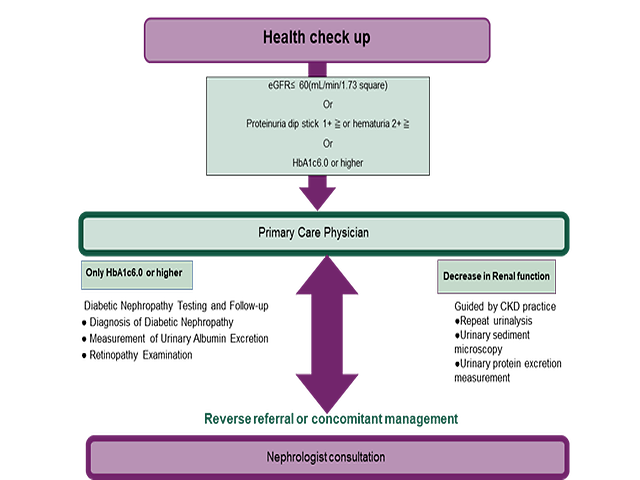
Figure 1: Kitakyushu
City CKD Prevention Collaboration System
2.
Increasing Enrollment of Patients to PD Program
through Patient education and shared decision making: we have
developed a robust pre-ESRD patient education program at KMH. At our center,
all CKD patients are referred to pre-ESRD education classes regardless of their
CKD stage. The educational team is comprised of nephrologists, nurses,
dieticians, pharmacists, social workers, physical therapists, and
psychologists. Using a teamwork approach, to allow patients and families to
understand various treatment options and make judicious decisions, thereby
allowing orderly planned initiation of the appropriate RRT (renal replacement
therapy) modality.
We also
developed a PD initiating program for patients as early as CKD stage 4 with an
eGFR<30, which englobes education about different RRT modalities and SDM
consultations at different stage until RRT decision (Figure 2). At least 3 SDM
consultations by doctors and nurses are planned before RRT decision. In case of
frail patients selecting PD, multiple home visits by nurses are scheduled.
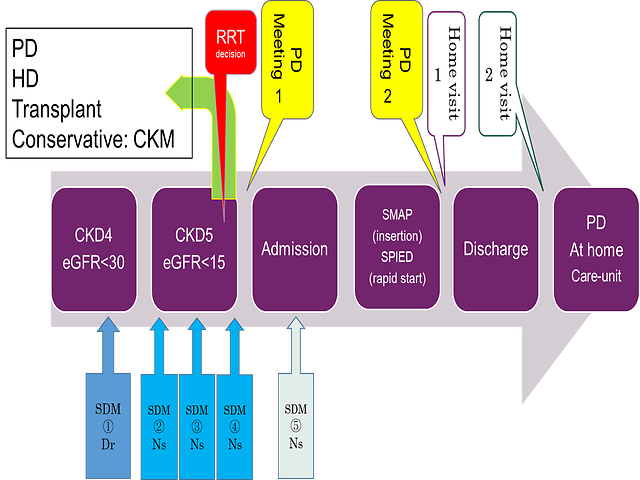
Figure 2: PD
Initiating Program at KMH
3.
Physicians and nurses training: a practicing
nephrologist and nurse who did not have adequate PD training will be reluctant
to offer this therapy. Moreover, ease with PD increases directly with
experience, and the centers become more adept at selecting patients to receive
PD and treating their complications. In our hospital they are exposed to all
aspects of PD including therapy initiation, routine care, evaluation of PD
prescription, and participation in multidisciplinary patient care plan meetings
and education.
4.
Successful PCPs/Nephrologists’ collaboration
model in PD: in managing a rapidly growing PD program, we faced
multiple challenges, which included labor constraints, and logistics. To
address these workforce and other challenges, we developed a medical
cooperation system that consists of a patient-centered care team of PCPs and a
multidisciplinary care team consisting of nephrologists, nurses, pharmacists,
dieticians and social workers.
This
cooperation system includes PCPs education programs and seminars, study
sessions and conferences, explanations of advantages of PD from an economic
standpoint and PD reimbursement system.
Clear role
segregation with the PCP role consisting of a bimonthly visit that includes a
weight check, amount of fluid removed, salt and fluid intake status, infection
prevention with exit site check and blood test prescription when needed, with
the reassurance of hospital availability 24h/7day in case of emergency or when
the PD prescription needs adjustment.
The patients
still need to visit our facility once every three months for regular checkups,
PET biannually, and for transfer set replacement. In addition, and during the
patient visits we also review dialysis prescriptions, staff members re-educate
patients regarding PD, their families and their support people, and examine
cardiovascular diseases non-invasively. This also provides patients, their
family, and the physicians with a sense of security (Figure 3)
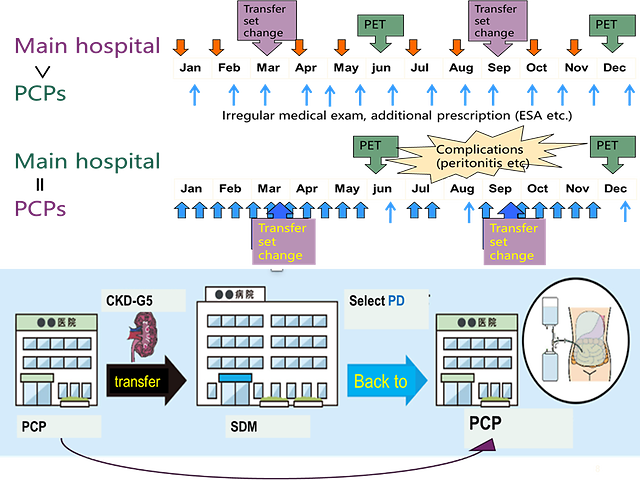
Figure 3: PCP and Nephrologist
collaboration model in PD
5.
Continuous quality improvement (CQI) program: PD outcomes
can be further improved by the implementation of a continuous quality
improvement (CQI) program to track the root cause of peritonitis, exit-site
infection, and technique failure, by careful data collection so that
appropriate interventions can be implemented.
Moreover to
keep the quality of our PD program, we hold twice a month a PD meeting for our
PD team (doctor, nurse, social workers, dieticians, pharmacologists) as well as
a quarterly to biannually PD meetings with our cooperating institutions that
consists of home doctors (not nephrologist), nursing home staffs, to share
information and discuss standard PD treatment and cardiovascular disease status
of all PD patients under reverse referral.
