CLINICAL PROFILE OF AKI IN PATIENTS WITH MALIGNANCY A SINGLE CENTRE EXPERIENCE


Certificate Output Instructions

For best output, select "Paper Size" as "A4" and "Margin" as "0" or "None".

To save or print to PDF, please select Print Destination > Save as PDF, enable Background Graphics under "More Settings", then click "Save".


Certificate Background


Presented the abstract " "
(Abstract co-author(s):  )


E-Poster Presentation

During the congress, E-Posters will be accessible to all participants on the congress website 24/7, as well as in the E-poster stations in the congress center. 

Preparing your E-Poster

Please review the E-Poster format requirements carefully when preparing your E-Poster. Should your E-Poster not meet the mentioned requirements, it may not be displayed as described above.

​E-Poster Submission Deadline

Please prepare and upload your E-Poster no later than March 14, 2026 11.59PM CET. After this date, you will no longer be able to prepare and upload your E-poster and it will not be displayed and accessible on the congress website.​

E-Poster Format Requirements
  • PDF file
  • Layout: Portrait (vertical orientation)
  • One page only (Dim A4: 210 x 297mm or PPT)
  • E-Poster can be prepared in PowerPoint (one (1) PowerPoint slide) but must be saved and submitted as PDF file.
  • File Size: Maximum file size is 2 Megabytes (2 MB)
  • No hyperlinks, animated images, animations, and slide transitions
  • Language: English
  • Include your abstract number
  • E-posters can include QR codes, tables and photos
 
CLINICAL PROFILE OF AKI IN PATIENTS WITH MALIGNANCY A SINGLE CENTRE EXPERIENCE

Please follow the instructions below to input your abstract title.

Abstract titles should be brief and reflect the content of the abstract.

  • The title will not be accepted if it exceeds 25 words.
  • Type in CAPITAL LETTERS.
  • Lowercase may be used for abbreviations only, for example, mRNA.
Mahesh
Kota
Mahesh Kota mahesh9700502390@gmail.com BASAVATARAKAM HOSPITAL NEPHROLOGY HYDERABAAD India *
-
-
-
-
-
-
-
-
-
-
-
-
-
-

With increasing awareness about malignancies ,treatment advances in malignancies and increased life expectancy in patients with malignant disease, renal dysfunction which was not addressed earlier know has gained much importance.In this background we observed clinical profile of patients with AKI(Acute Kidney Injury) with background malignancy.

A total of 200 cancer patients with AKI admitted in Basavatarakam Indo American

Cancer hospital, Hyderabad, India were studied.

Out of 200 patients in the study, 124 were males and 76 were females.

Most of the patients are in 51 to 60 years age group(80 patients) and the mean

age of the patients was 54.76 years.

COMORBIDS-FIGURE 1

Hypertension was the common comorbid illness seen in 140 patients followed

by diabetes mellitus seen in 48 patients.

RENAL BIOPSIES IN PATIENTS WITH MALIGNANCY

Renal biopsy was done in 9 patients, where cast nephropathy was seen in

patients with multiple myeloma, chronic tubulointerstitial nephritis was seen in

amyloidosis, ATIN(acute tubule interstitial nephritis) and ATN(acute tubular

necrosis) was seen in lung cancer, membranous nephropathy and acute

interstitial nephritis was seen in renal cell carcinoma and thrombotic

microangiopathy was seen in a patient with AKI who underwent bone marrow

transplantation for aplastic anemia.

STAGES OF AKI

Out of 200 patients in the study group, AKI of AKIN I was seen in 64 members, AKIN

II was seen in 68 members and AKIN III was seen in 68 members.

MALIGNANCY TYPES (N=200) -FIGURE 2


Bladder cancer was common malignancy seen in 24 patients, followed by breast

cancer, lung cancer and AML seen in 20 patients.

CAUSES OF AKI IN PATIENTS WITH MALIGNANCY- FIGURE 3


Multifactorial AKI was seen in 44 patients ,though each and every variant of

malignancy has specific cause of AKI, sepsis was commonly seen in all types of

malignancies.

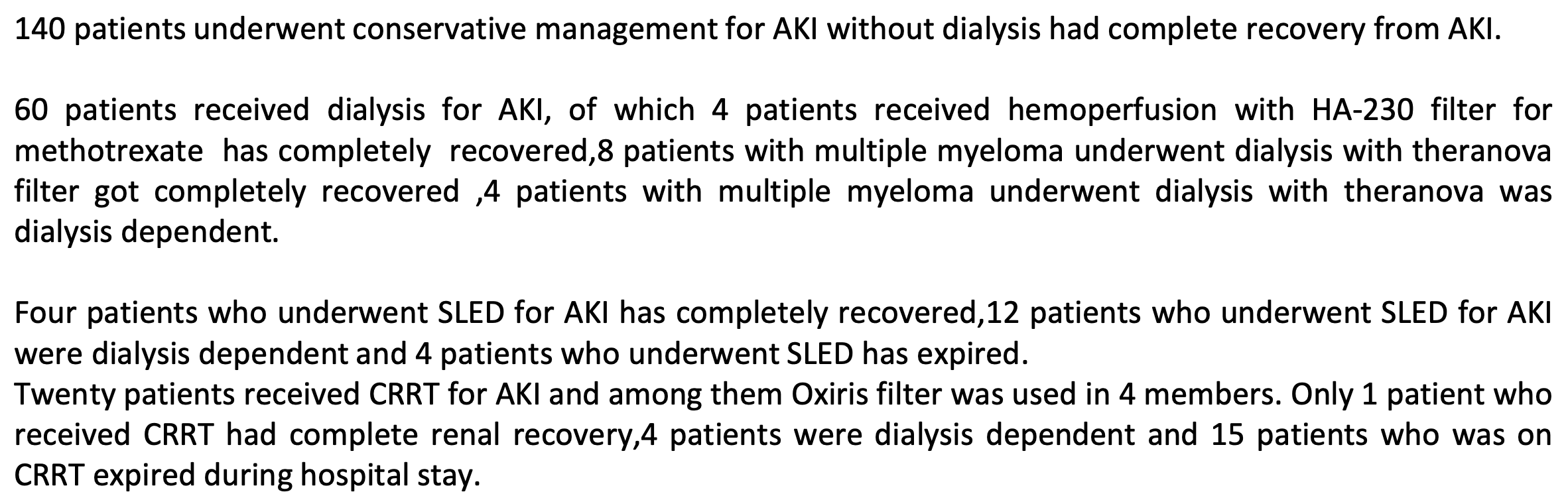
TYPES OF EXTRA CORPOREAL THERAPIES OFFERED-FIGURE 4


OUT COMES OF THE STUDY-FIGURE 5


Sepsis was the common cause of AKI in many cancer variants.

More the severity of AKI was associated with more adverse out

comes.

All types of AKI like pre-renal, intrinsic renal and obstructive

element was seen in patients with AKI in the background of

malignancy.

Kewords
