VERIFYING THE SAFETY OF TAUROLOCK AND CLEARGUARD HD COMBINATION USE


Certificate Output Instructions

For best output, select "Paper Size" as "A4" and "Margin" as "0" or "None".

To save or print to PDF, please select Print Destination > Save as PDF, enable Background Graphics under "More Settings", then click "Save".


Certificate Background


Presented the abstract " "
(Abstract co-author(s):  )


E-Poster Presentation

During the congress, E-Posters will be accessible to all participants on the congress website 24/7, as well as in the E-poster stations in the congress center. 

Preparing your E-Poster

Please review the E-Poster format requirements carefully when preparing your E-Poster. Should your E-Poster not meet the mentioned requirements, it may not be displayed as described above.

​E-Poster Submission Deadline

Please prepare and upload your E-Poster no later than March 14, 2026 11.59PM CET. After this date, you will no longer be able to prepare and upload your E-poster and it will not be displayed and accessible on the congress website.​

E-Poster Format Requirements
  • PDF file
  • Layout: Portrait (vertical orientation)
  • One page only (Dim A4: 210 x 297mm or PPT)
  • E-Poster can be prepared in PowerPoint (one (1) PowerPoint slide) but must be saved and submitted as PDF file.
  • File Size: Maximum file size is 2 Megabytes (2 MB)
  • No hyperlinks, animated images, animations, and slide transitions
  • Language: English
  • Include your abstract number
  • E-posters can include QR codes, tables and photos
https://storage.unitedwebnetwork.com/files/1099/bf511ff06f65ee12443828fac140250d.pdf
VERIFYING THE SAFETY OF TAUROLOCK AND CLEARGUARD HD COMBINATION USE

Please follow the instructions below to input your abstract title.

Abstract titles should be brief and reflect the content of the abstract.

  • The title will not be accepted if it exceeds 25 words.
  • Type in CAPITAL LETTERS.
  • Lowercase may be used for abbreviations only, for example, mRNA.
Jue
Wang
Jue Wang jue.wang@health.qld.gov.au Royal Brisbane and Women's Hospital Metro North Kidney Health Service Brisbane Australia *
zenaw Wolie z.wolie@student.uq.edu.au The University of Queensland UQCCR Brisbane Australia -
-
-
-
-
-
-
-
-
-
-
-
-
-

1 Background

1.1 what is Taurolock TM

Taurolock TM is a catheter lock solution to be used with catheter-based vascular access devices, which assists with the device patency and provides infection control. It is a clear solution that contains taurolidine (1.35%), citrate (4%) and heparin. Depending on the concentration of heparin there are three TaurolockTM variants namely TaurolockTM-HEP100, Taurolock TM-HEP500, and Taurolock TM-U25,000 which contain heparin 100IU/ml, 500IU/ml, and 5,000IU/ml respectively (TauroPharm GmbH, n.d.). Several trials have been conducted and concluded this lock solution’s significant effect in reducing central-line associated blood stream infection (CLABSI) (Scaglione et al., 2025; Shabaan et al., 2025; Tribler et al., 2017).


1.2 what is the triple effect of TaurolockTM

Taurolidine—one component of Taurolock works against gram positive and gram negative bacteria and fungi by biding its hydroxymethyl group to microbial cell walls, leading to cell death (Shabaan et al., 2025). The combination of an antimicrobial agent (taurolidine) with an anticoagulant component (heparin) was found to be efficient in prevention of biofilm, infections, and occlusion (Arechabala et al., 2018).


1.3 why doing a safety check

In Metro North Kidney Health Service Australia, TaurolockTM-HEP500 is used as a CVC lock solution within the usual clinical care. This practise differs from that in previous trials(Brunelli et al., 2018; Hymes et al., 2017), where normal saline was the locking solution used. A pilot RCT (Australian New Zealand Clinical Trials Registry

NCT 07019610) is underway to assess the feasibility of using an antimicrobial barrier cap—ClearGuard HD in renal central veinous catheters (CVCs) to reduce the risk of CLABSIs. This end cap contains a male luer lock rod that incorporates an antimicrobial agent (Chlorhexidine) on its surface designed to reduce microbial colonisation. Thus, prior to using ClearGuard HD end cap in combination with Taurolock HEP500, we sought additional safety data and assurance.


The QLD Medicines Advice & Information Services was consulted regarding the compatibility of these two products. Their background research noted that as Taurolock was not a surfactant, but rather a neutral, non-ionic molecule based on its composition, it was deemed to have a low likelihood of any interactions with chlorhexidine.


We also approached TaurolockTM manufacturer Prima MediPham Pty Ltd Product & Sales manager who confirmed that TaurolockTM was an aqueous solution that does not contain components likely to precipitate or react chemically with chlorhexidine.

Besides the all-in-all minimal concerns, safety measures must still be considered due to the differences in Australian practise prior to commencing the RCT trial mentioned above.

2 Objectives

To verify the safety of using TaurolockTM- HEP500 combining Clearguard HD

3 Methods

To ensure that the compatibility between Taurolock and Chlorhexidine in the ClearGuard was investigated thoroughly, a small-scale compatibility study was designed and conducted in collaboration with the UQCCR (the University of Queensland center for clinical research) staff to observe the change in pH, particle sizes, and appearance (such as colour, clarity, and formation of turbidity).

3.1 Sample Preparation and Experimental Setup

A total of four sets of samples were prepared: 

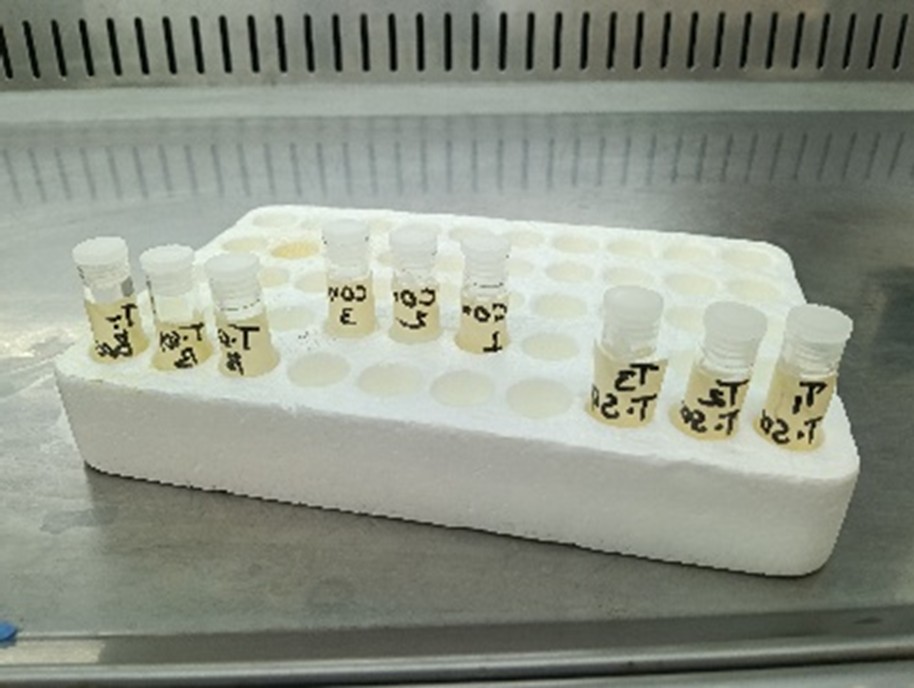
1.      Taurolock with ClearGuard Rods: ClearGuard HD rods were cut and placed into three replicate vials, each containing 3 mL of TaurolockTM- HEP500. These were designated as T1, T2, and T3 (Test 1, Test 2, and Test 3).

2.      Saline with ClearGuard Rods: Three replicate vials, each containing 3 mL of normal saline, were prepared by cutting and adding ClearGuard HD rods. These were designated as C1, C2, and C3 (Control 1, Control 2, and Control 3).  

3.      Taurolock Without ClearGuard Rods: Three replicate vials containing 3 mL of TaurolockTM- HEP500 solution without ClearGuard rods were prepared as B1, B2, and B3 (Blank 1, Blank 2, and Blank 3).

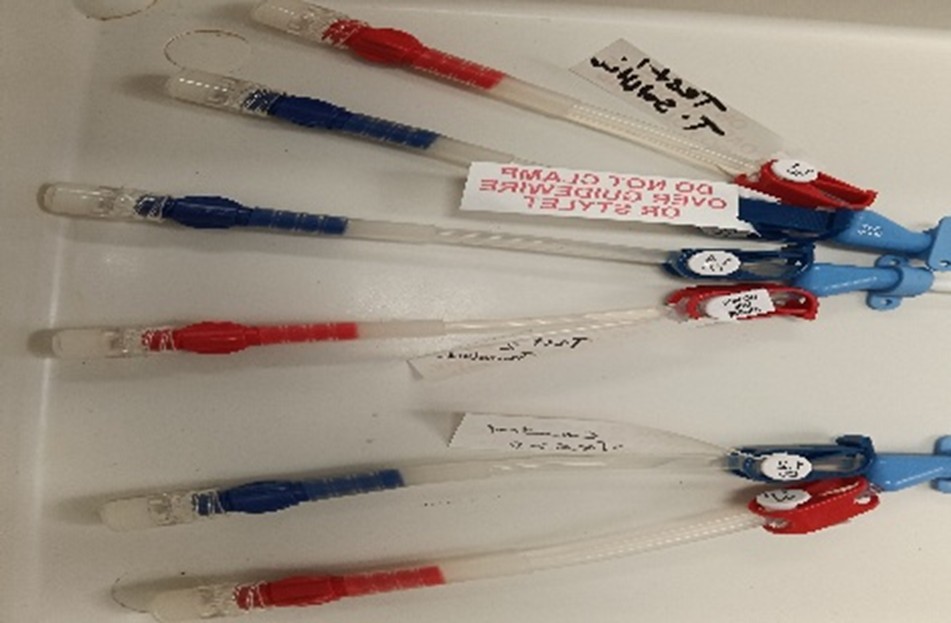
4.      Taurolock and Saline in CVC Lumens: TaurolockTM- HEP500 was instilled into two central venous catheter (CVC) lumens, CVC1 and CVC2, while saline was used for the third lumen, CVC3. 

After preparation, all samples were kept in an incubator at 32°C for 72 hours with a rotation speed of thirty revolutions per minute (RPM) to simulate real clinical practice conditions. See figures below:

Fig1 preparation1,2,3
preparation1,2,3

Fig2 preparation4

3.2 Measurements 

The pH of TaurolockTM- HEP500 with ClearGuard Rods, Saline with ClearGuard Rods, and Taurolock without ClearGuard Rods (preparation1,2,3) were measured daily using a HORIBA compact pH meter to assess any changes. However, the pH of Taurolock and Saline in CVC lumens (preparation4) was measured only at the end of the experiment, as the solution volume in the lumens was insufficient for daily pH measurements. Similarly, physical characteristics such as changes in color, clarity, and turbidity formation were assessed daily for all preparations using visual inspection methods. In addition, particle size counting was performed at baseline for Taurolock without ClearGuard Rods (preparation3) and at the end of the experiment for Taurolock and Saline with ClearGuard Rods (preparation1,2), using the HIAC 9703 counting machine. The objective was to observe any changes between the baseline Taurolock solution and the Taurolock and Saline solutions with ClearGuard after 72 hours of storage.

The pH measurements for each preparation were summarized as follows. As shown in the table (table1), the pH of the preparations, whether containing ClearGuard or not, remained the same throughout the storage duration and under the given storage conditions. Similarly, during the experiment, there was no change in color, clarity, or turbidity in any of the preparations. Furthermore, particle size measurements taken after 72 hours of storage for both the Taurolock (T1, T2, T3) and saline (C1, C2, C3) solutions containing ClearGuard showed no significant changes compared to the baseline measurements of the Taurolock solution without ClearGuard (B1, B2, B3) (See Table2).

Table1 PH readings

Samples

Baseline (0 hours)

24 hours

48 hours

72 hours

Mean

T1

5.97

6.05

6.03

6.06

6.03

T2

6.07

6.11

6.00

6.08

6.06

T3

6.07

6.14

6.01

6.06

6.07

C1

6.21

6.15

6.14

6.11

6.15

C2

6.08

6.21

6.13

6.12

6.14

C3

6.09

6.10

6.10

6.09

6.10

B1

6.08

6.11

6.01

6.03

6.08

B2

6.10

6.15

6.01

6.07

6.08

B3

6.08

6.11

6.03

6.10

6.08

CVC1

-

-

-

6.09


CVC2

-

-

-

6.11


CVC3

-

-

-

6.10


Table2 Particle size measurements

Samples

Time

Subvisible particle cumulative counts per milliliter for particles ≥10 and 25 µm

Measurement result for each replicate


Mean

1

2

3

Taurolock without ClearGuard (B1, B2, B3)

0

10 µm

28.33

23.33

53.33

35.00

25 µm

0

1.67

0

0.56

Taurolock with ClearGuard (T1, T2, T3)

72hrs

10 µm

28.33

10

6.67

15.00

25 µm

5

1.67

0

2.22

Saline with ClearGuard (C1, C2, C2)

72hrs

10 µm

25

5

40

23.33

25 µm

0

0

3.33

1.11

5 Conclusion

According to the result from this small-scale vitro-trial—no significant changes in pH and appearance across all four preparations, no significant changes in particle sizes in preparation 1 to 3. Due to the differences in practice between the USA and Australia, safety concerns have been placed upon using Taurolock as the central vein catheter lumen lock solution instead of normal saline. This experiment further secured the safety of combination use of Taurolock and ClearGuard HD within the designed pilot study.

Kewords