Relationship between social vulnerability and evolution of glomerular filtration rate in patients with polycystic kidney disease


Certificate Output Instructions

For best output, select "Paper Size" as "A4" and "Margin" as "0" or "None".

To save or print to PDF, please select Print Destination > Save as PDF, enable Background Graphics under "More Settings", then click "Save".


Certificate Background


Presented the abstract " "
(Abstract co-author(s):  )


E-Poster Presentation

During the congress, E-Posters will be accessible to all participants on the congress website 24/7, as well as in the E-poster stations in the congress center. 

Preparing your E-Poster

Please review the E-Poster format requirements carefully when preparing your E-Poster. Should your E-Poster not meet the mentioned requirements, it may not be displayed as described above.

​E-Poster Submission Deadline

Please prepare and upload your E-Poster no later than March 14, 2026 11.59PM CET. After this date, you will no longer be able to prepare and upload your E-poster and it will not be displayed and accessible on the congress website.​

E-Poster Format Requirements
  • PDF file
  • Layout: Portrait (vertical orientation)
  • One page only (Dim A4: 210 x 297mm or PPT)
  • E-Poster can be prepared in PowerPoint (one (1) PowerPoint slide) but must be saved and submitted as PDF file.
  • File Size: Maximum file size is 2 Megabytes (2 MB)
  • No hyperlinks, animated images, animations, and slide transitions
  • Language: English
  • Include your abstract number
  • E-posters can include QR codes, tables and photos
https://storage.unitedwebnetwork.com/files/1099/dae871ef6cc6dfa435aea8357e1a178c.pdf
Relationship between social vulnerability and evolution of glomerular filtration rate in patients with polycystic kidney disease

Please follow the instructions below to input your abstract title.

Abstract titles should be brief and reflect the content of the abstract.

  • The title will not be accepted if it exceeds 25 words.
  • Type in CAPITAL LETTERS.
  • Lowercase may be used for abbreviations only, for example, mRNA.
Jaime Arturo
Dulce
Jaime Arturo Dulce jadulcem@gmail.com Simón Bolívar University Nephrology Barranquilla Colombia *
Carlos Guido Musso drcarlosmusso@gmail.com Research Department, Italian Hospital of Buenos Aires Nephrology Buenos Aires Argentina -
Gustavo Aroca gustavo.aroca@unisimon.edu.co Simón Bolívar University Nephrology Barranquilla Colombia -
Eveling Alvarez Mora evalvarez95m@gmail.com Clinical Nutrition Nutrition Barranquilla Colombia -


Polycystic kidney disease (PCD) is the main hereditary kidney disease worldwide (1). It is characterized by the progressive formation of multiple renal cysts, which increase renal volume and replace the functional parenchyma, hypertension also occurs (2). Over time, glomerular destruction impairs filtration, leading to chronic kidney disease and the need for renal replacement therapy in certain cases (3).

In terms of pathophysiology, PKD is mainly associated with mutations in the PKD1 and PKD2 genes, with autosomal dominant inheritance predominating. However, there are cases without mutations in these genes, affecting other loci conditioning an earlier and more severe presentation of the disease (4).

PKD is a multisystem pathology with extra-renal cystic and non-cystic manifestations. The former include brain, liver, and gastrointestinal cysts. Non-cystic manifestations include aortic and cerebral aneurysms, heart valve abnormalities, colonic diverticula, and abdominal hernias (5)(6). The most frequent clinical manifestations, related to pathophysiology, are back pain, hematuria, urinary tract infections and lithiasis (7).

Globally, an estimated 12 million people suffer from ERP, with approximately 600,000 cases in the United States (8). In the European Union, prevalence ranges from 2.41 to 3.89 cases per 10,000 population, and about 91.1 cases per million people require replacement therapy due to PKD (9). In Colombia, information is limited; the former Social Security Institute reported a prevalence of 4.6% in patients with stage 4 chronic kidney disease (10).

In the context of chronic kidney disease, social vulnerability acts as a determining factor that significantly increases the risk of clinical decompensation, delay in diagnosis, limited access to appropriate treatments and, consequently, a higher mortality rate (11). The objective of this study was to make a correlation between ERP and the social vulnerability score (SOVI).


A retrospective, cross-sectional and unicenter study was conducted through the review and analysis of clinical records and existing databases of adult patients diagnosed with PKD in a tertiary referral center in the Colombian Caribbean between 2008 and 2025. The inclusion criteria included patients with a diagnosis of PKD over 18 years of age, and among the exclusion criteria, patients with incomplete information stand out. A total of 75 patient records were obtained, relative and absolute frequency were performed in the analysis of qualitative variables, and for quantitative variables, the Shapiro-Wilk normality test and measures of central tendency (mean, median, standard deviation, interquartile range) were performed. In addition, the correlation between vulnerability score and delta TFG was calculated using Spearman's coefficient using SPSS 23 software. The study has the instructions of the Declaration of Helsinki and approval of the institutional ethics committee.


A study was conducted in 75 patients with polycystic kidney disease to explore the correlation between this pathology and social vulnerability. The sample was composed mostly of individuals of mestizo ethnicity (90.7%), with male predominance (58.7%) and a high concentration in low socioeconomic strata (37.3% in stratum 1). The social vulnerability score showed that 68% of the subjects had a high level of vulnerability, category 3 (greater vulnerability). Clinical variables such as arterial hypertension were found in (68%), type 2 diabetes mellitus (8%). see table 1. 
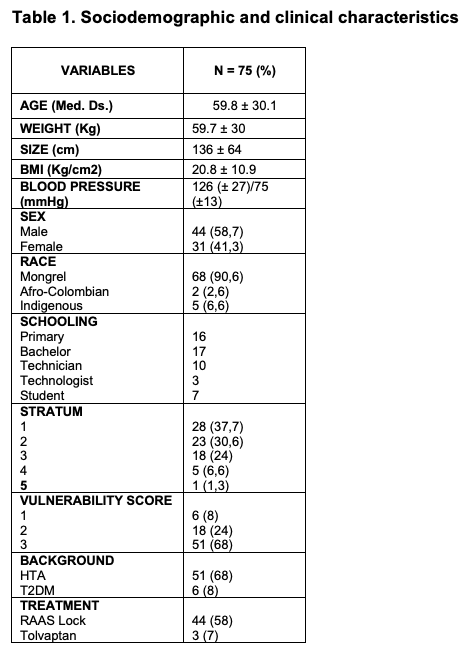
Table 1. Sociodemographic and clinical characteristics

In descriptive analyses, the mean glomerular filtration rate at the beginning of follow-up was 50.8 mL/min/1.73m², decreasing on average 2.99 mL/min/1.73m² during the period analyzed. The group showed a high prevalence of arterial hypertension (68%) and symptoms associated with the disease (70.7%). The average initial creatinine was 2.81 and the final creatinine was 2.29, other data are shown in Table 2.
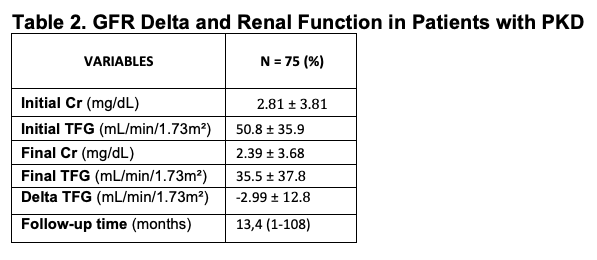
Table 2. GFR Delta and Renal Function in Patients with PKD

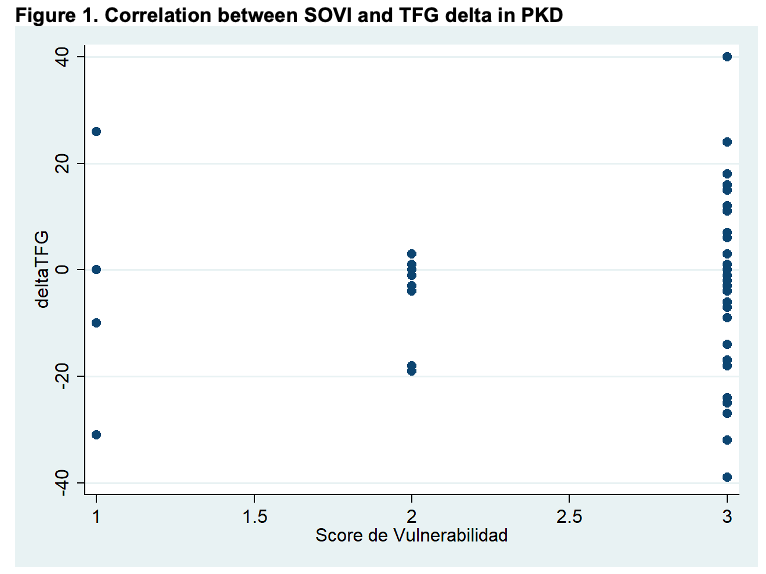
The correlation between the social vulnerability score and the glomerular filtration rate (IA) delta was evaluated using Spearman's correlation coefficient, resulting in a coefficient rho=0.0596 with a value p=0.6114, indicating that there is no statistically significant correlation between social vulnerability and the progression of kidney damage measured as a change in GFR in this cohort.  See graph 1.


Analysis and discussion

PKD is a multi-organ disease whose determining factors in progression include genetic aspects (mutations in PKD1, PKD2) and clinical aspects (blood pressure control, use of RAAS blockers, presence of comorbidities)(15). This study provides evidence that social vulnerability, although elevated in most patients, is not significantly associated with the acceleration of kidney damage as measured by the decrease in GFR. This may be explained by the fact that the vulnerability score used may not capture social factors that directly impact renal function, or that other clinical variables have a greater weight on the progression of ERP. Previous studies indicate that the control of cardiovascular and genetic risks is more decisive in renal evolution than isolated social variables (Chebib & Torres, 2018; Cornec-Le Gall et al., 2019)(16)(17). However, the high prevalence of social vulnerability reflects the need for comprehensive care, considering social determinants that may affect adherence and quality of life (Musso et al., 2024)(11).

In addition, the presence of hypertension in 68% of the sample, a recognized factor for the worsening of ERP, emphasizes the importance of clinical management to slow progression. There may be indirect effects of social vulnerability on the control of these conditions that are not evident in this analysis with delta GFR in the short term.


Most of the patients analyzed presented high social vulnerability. Although a slight average decrease in GFR was observed, the correlation between the vulnerability score and the variation in glomerular filtration rate was not significant. The results suggest that additional factors, such as blood pressure control, use of RAAS blockers or tolvaptan, could influence progression.

The lack of significant correlation between social vulnerability and change in kidney function suggests that, in this sample, social vulnerability is not directly related to the measurable progression of polycystic kidney disease. It is possible that other clinical or genetic factors have a greater weight in progression, or that the vulnerability score used does not adequately capture aspects that directly impact renal function.

Additional analyses including clinical, genetic, and treatment variables are needed to assess their impact on renal progression.

The high proportion of patients in low strata and with high vulnerability highlights the significant social burden faced by these patients, which could affect other aspects of their quality of life and adherence to treatment. A comprehensive approach combining medical care with social interventions to improve outcomes in patients with ERP is suggested.



In this population with PKD in the Colombian Caribbean, social vulnerability did not show a significant association with the progression of renal function measured as a change in glomerular filtration rate. Renal progression seems to be more influenced by biological and clinical factors. Longitudinal studies that include genetic variables, adherence, and therapeutic management are required to delve into the social impact on the evolution of PRD.

The design of multidisciplinary interventions that integrate rigorous clinical control with social support is recommended to improve overall outcomes in patients with polycystic kidney disease.

Analysis based on summary data limits causal interpretation, but provides descriptive evidence on the ERP population.


Kewords