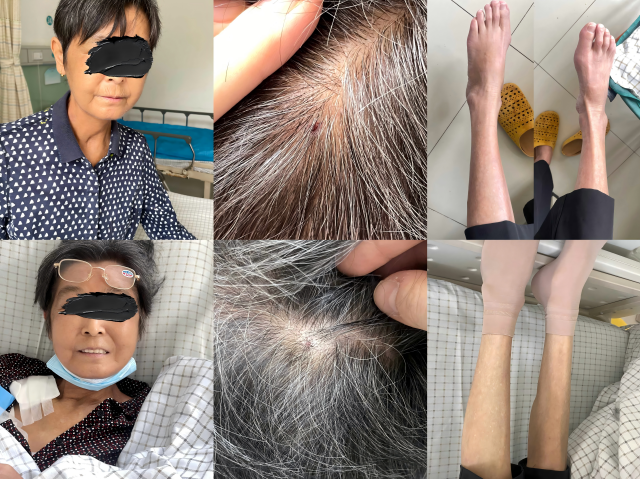
 The patient, a 60-year-old female with a history of liver transplantation for decompensated cirrhosis, developed hepatorenal syndrome and initiated maintenance hemodialysis for CKD Stage 5 on February 17, 2025. During her course, she experienced recurrent spontaneous bacterial peritonitis (pathogen: vancomycin-resistant Enterococcus faecium) necessitating multiple courses of broad-spectrum antibiotics (including cefoperazone-sulbactam, meropenem, daptomycin, linezolid). On April 17, she developed severe generalized pruritus accompanied by urticaria on the trunk and limbs. Initially suspected as a drug allergy, all potential culprit medications were discontinued, and prednisone was administered. While the urticarial rash resolved and the infection was controlled, intense pruritus affecting the head, arms, back, palms, and soles persisted, notably worsening at night, severely impairing sleep and quality of life. Based on her history and laboratory findings on April 19 (ALP 492 U/L, γ-GTP 412 U/L, BUN 18.9 mmol/L, SCr 482 μmol/L), a diagnosis of "Uremic Pruritus complicated by Cholestatic Pruritus" was established. Despite trials of various standard therapies including antihistamines, intensified hemodialysis with hemoperfusion, gabapentin, ursodeoxycholic acid, sertraline, topical tacrolimus ointment, and achieving targets for phosphate and parathyroid hormone control, the generalized pruritus remained refractory. After thorough evaluation and exclusion of contraindications, nalfurafine (2.5 μg orally once nightly) was initiated. Following treatment, the patient's pruritus significantly improved within 5 days, with the Visual Analog Scale (VAS) score decreasing from 7 to 2. Sleep quality markedly improved. No significant adverse effects, such as nausea, dizziness, somnolence, or further elevation in AST, ALT, ALP, or γ-GTP levels, were observed during treatment.
A review of the literature indicates that pruritus is a common and distressing comorbidity in both uremia and chronic liver disease, with complex and multifactorial pathophysiology. UP is associated with μ-opioid receptor pathway overexpression, immune dysregulation, microinflammation, and xerosis. CP is primarily linked to bile acid accumulation, endogenous opioid system imbalance, and mediators like lysophosphatidic acid (LPA). Nalfurafine, a highly selective κ-opioid receptor agonist, is believed to exert its antipruritic effect by activating central κ-receptors, thereby counteracting μ-receptor-mediated pruritogenic signaling, and may also modulate bile acid-related itch pathways. Multiple randomized controlled trials have established the efficacy of nalfurafine in ameliorating UP in hemodialysis patients. In this complex case, characterized by dual UP and CP pathophysiology, multiple infections, polypharmacy, and drug hypersensitivity, nalfurafine demonstrated notable efficacy and excellent tolerability. This outcome underscores its mechanistic advantage and potential therapeutic value in challenging clinical scenarios involving mixed-origin pruritus.
