REDEFINING THE GLOBAL LANDSCAPE OF KIDNEY GENETICS CARE: SCOPING REVIEW, INTERNATIONAL STAKEHOLDER CONSULTATION, AND THEORY-GROUNDED SYNTHESIS OF A GLOBAL IMPLEMENTATION ROADMAP


Certificate Output Instructions

For best output, select "Paper Size" as "A4" and "Margin" as "0" or "None".

To save or print to PDF, please select Print Destination > Save as PDF, enable Background Graphics under "More Settings", then click "Save".


Certificate Background


Presented the abstract " "
(Abstract co-author(s):  )


E-Poster Presentation

During the congress, E-Posters will be accessible to all participants on the congress website 24/7, as well as in the E-poster stations in the congress center. 

Preparing your E-Poster

Please review the E-Poster format requirements carefully when preparing your E-Poster. Should your E-Poster not meet the mentioned requirements, it may not be displayed as described above.

​E-Poster Submission Deadline

Please prepare and upload your E-Poster no later than March 14, 2026 11.59PM CET. After this date, you will no longer be able to prepare and upload your E-poster and it will not be displayed and accessible on the congress website.​

E-Poster Format Requirements
  • PDF file
  • Layout: Portrait (vertical orientation)
  • One page only (Dim A4: 210 x 297mm or PPT)
  • E-Poster can be prepared in PowerPoint (one (1) PowerPoint slide) but must be saved and submitted as PDF file.
  • File Size: Maximum file size is 2 Megabytes (2 MB)
  • No hyperlinks, animated images, animations, and slide transitions
  • Language: English
  • Include your abstract number
  • E-posters can include QR codes, tables and photos
https://storage.unitedwebnetwork.com/files/1099/11b9034bfb16d9efc77b3e7ab89bc7c3.pdf
REDEFINING THE GLOBAL LANDSCAPE OF KIDNEY GENETICS CARE: SCOPING REVIEW, INTERNATIONAL STAKEHOLDER CONSULTATION, AND THEORY-GROUNDED SYNTHESIS OF A GLOBAL IMPLEMENTATION ROADMAP

Please follow the instructions below to input your abstract title.

Abstract titles should be brief and reflect the content of the abstract.

  • The title will not be accepted if it exceeds 25 words.
  • Type in CAPITAL LETTERS.
  • Lowercase may be used for abbreviations only, for example, mRNA.
Ru Sin
Lim
Ru Sin Lim limrusin@gmail.com Tan Tock Seng Hospital Department of Renal Medicine Singapore Singapore *
Trudie Harris Trudie.Harris@health.qld.gov.au Townsville University Hospital Townsville Institute of Health Research and Innovation Townsville Australia -
Julia Jefferis julia.jefferis@my.jcu.edu.au Mater Health Service Department of Nephrology Brisbane Australia -
Sadia Jahan sadia.jahan@my.jcu.edu.au Royal Adelaide Hospital Central and Northern Adelaide Renal and Transplantation Services Adelaide Australia -
Regina Shaoying Lim regina.lim@nhghealth.com.sg Tan Tock Seng Hospital Department of Renal Medicine Singapore Singapore -
Louisa M D’Arrietta louisa.darrietta@jcu.edu.au Townsville University Hospital Library Services Townsville Australia -
Kar Hui Ng paenkh@nus.edu.sg National University Health System Khoo Teck Puat-National University Children’s Medical Institute Singapore Singapore -
Hui-Lin Chin paechin@nus.edu.sg National University Health System Khoo Teck Puat-National University Children’s Medical Institute Singapore Singapore -
Liuh Ling Goh liuh.ling.goh@nhghealth.com.sg Tan Tock Seng Hospital Molecular Diagnostic Laboratory Singapore Singapore -
Sanchalika Acharyya sanchalika.acharyya@nhghealth.com.sg Tan Tock Seng Hospital Clinical Research and Innovation Office Singapore Singapore -
Edwin Shih-Yen Chan edwin.chan@scri.cris.sg Singapore Clinical Research Institute Singapore Singapore Clinical Research Institute Singapore Singapore Singapore -
Chirag Patel Chirag.patel2@health.qld.gov.au Royal Brisbane & Women's Hospital Genetic Health Queensland Brisbane Australia -
Erik Biros erik.biros@jcu.edu.au James Cook University College of Medicine and Dentistry Townsville Australia -
Andrew J. Mallet andrew.mallett@health.qld.gov.au Townsville University Hospital Townsville Institute of Health Research and Innovation Townsville Australia -
Nick Sevdalis nick_sev@nus.edu.sg Yong Loo Lin School of Medicine, National University Singapore Centre for Behavioural and Implementation Science Interventions (BISI) Singapore Singapore -

Successful implementation of kidney genetics services is critical to improve patient, service, and implementation outcomes. Yet, implementation-focused evidence in this space remains limited. In this Part 2 companion analysis, we synthesize determinants—barriers and facilitators, and align them to tailored strategies for implementation, integrating a global scoping review and international survey.

We conducted a scoping review (JBI methodology, PRISMA-ScR compliant; OSF registered) of English-language publications (2000–2025) reporting determinants of kidney genetics implementation. 2 reviewers coded and quantified determinants using the Consolidated Framework for Implementation Research (CFIR) across 5 domains: innovation, individuals, inner setting, outer setting, and process. Top-ranked barriers were matched to strategies using the Expert Recommendations for Implementing Change (ERIC) tool. In parallel, a 42-item survey of international clinic leads captured real-world determinants and strategies. Findings were synthesized across both review and survey data.

Of 60 studies; 28 reported determinants (4 explicit, 24 implicit): North America (NA) 16, Australia/New Zealand (ANZ) 4, United Kingdom (UK)/Ireland 3, and Europe (EU) 5.

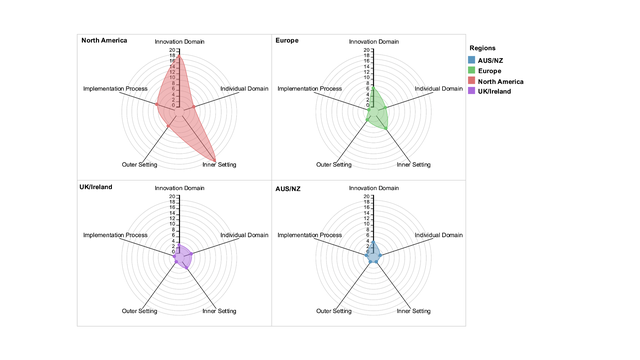
Barriers: NA: individual (18) and outer setting (29) predominated, notably limited implementation team capability/motivation (13), low care recipients capability/motivation (5), financing constraints (14), and insurer pre-authorization requirement (9). ANZ: individual (15) and inner setting (15) predominated with lack of available resources (4), culture (3), infrastructure (3), limited access to knowledge (2), weak relational connections (2), and financing gap (1). Reporting from UK/EU was limited: innovation (7) with service complexity (5) reported most often. Domain-stratified barriers across regions are shown in Fig 1-2.

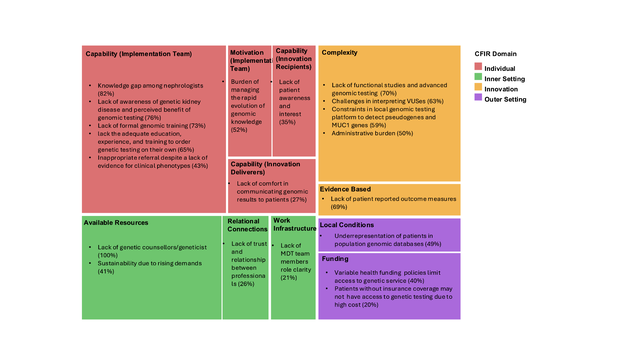
51 survey responses corroborated the review patterns (Fig 3).

Top barriers in descending orders: implementation team capability (22), financing (16), innovation complexity (14), policies/laws (10), available resources (9), and team motivation (8).

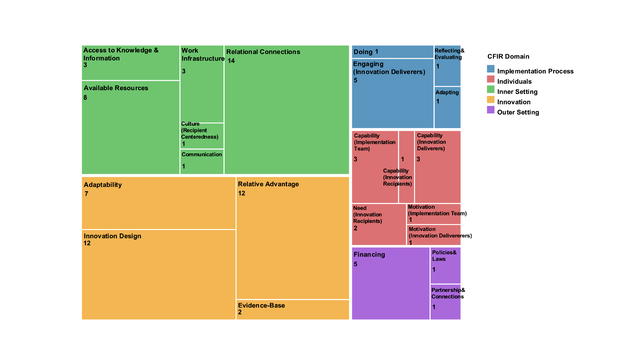
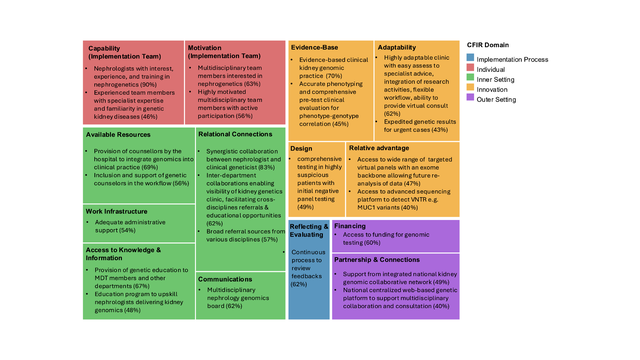
Facilitators: Across regions, innovation (33) and inner setting (30) predominated. Within innovation, relative advantage (12), design quality (12), adaptability (7), and evidence-base (2) supported implementation. Within inner setting, strong relational connections (14), available resources (8), access to knowledge/information (3), and genetics-centered culture (2) enabled implementation.

Domain-stratified facilitators are shown in Fig 4-5; survey responses mirrored the review findings (Fig 6).

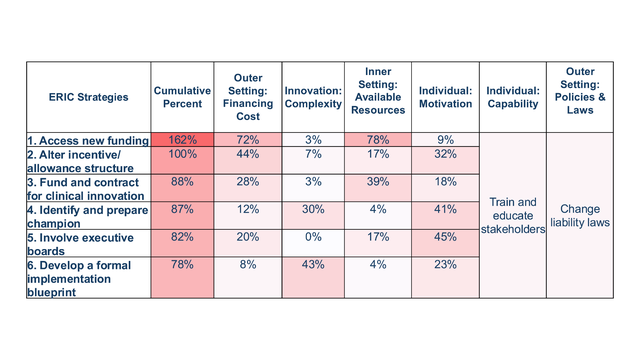
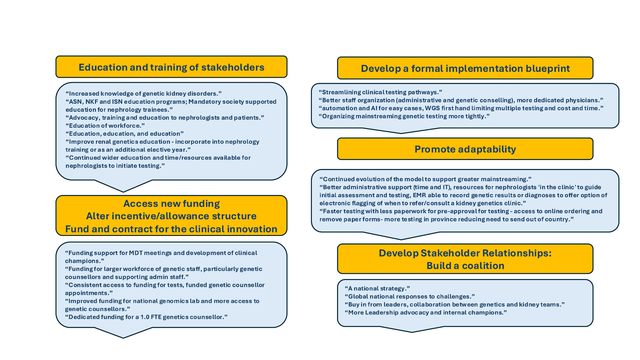
Strategies: Top matched strategies using ERIC tool in descending orders: train/educate stakeholders, change liability laws, secure funding 162%, alter incentive structure 100%, fund clinical innovation 88%, identify and prepare champions 87%, involve executive boards 82%, develop a formal implementation blueprint 78% (Fig 7). Strategies proposed by global leads mimicked ERIC-derived priorities (Fig 8).
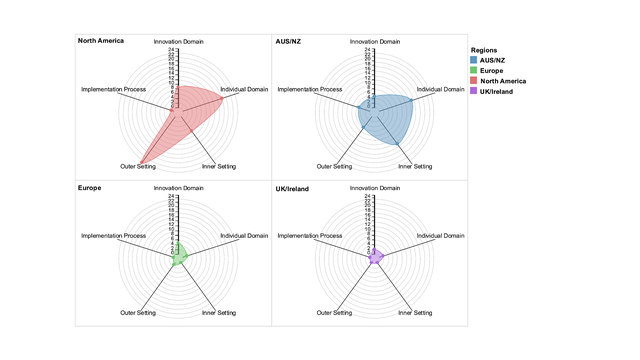
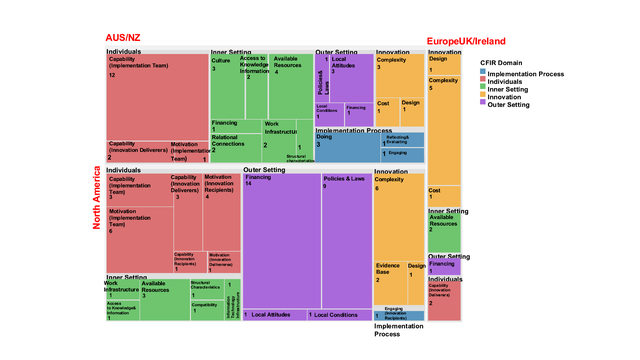
Figure 1: Barriers Across 5 CFIR Domains by RegionFigure 2: Treemap Chart of Barriers Across 5 CFIR Domains and Sub-domains by RegionFigure 3: Barriers Reported by Survey RespondentsFigure 4: Facilitators Across 5 CFIR Domains by RegionFigure 5: Facilitators Across 5 CFIR Domains and Sub-domains in All RegionsFigure 6: Facilitators Reported by Survey RespondentsFigure 7: Heatmap Chart of Top Barriers Matched to Strategies using ERIC Tool

Barriers vary by region, while facilitators converge on innovation and inner setting domains. Our CFIR-ERIC synthesis yields a prioritized strategy bundle ready for pragmatic hybrid trials to improve outcomes. Under-representation of Asia, Africa, and South America is a critical equity gap requiring targeted research and policy partnerships.

Kewords